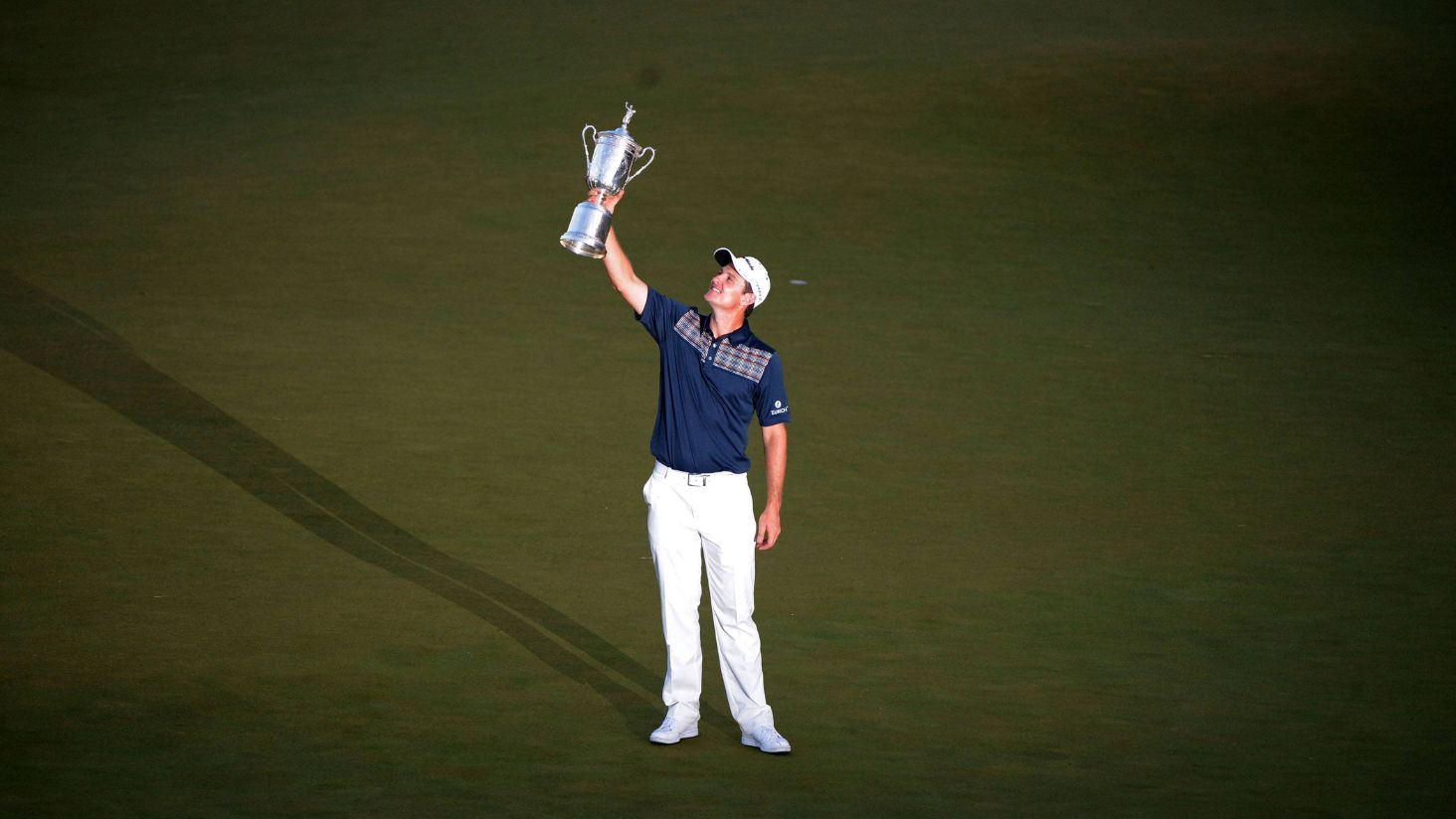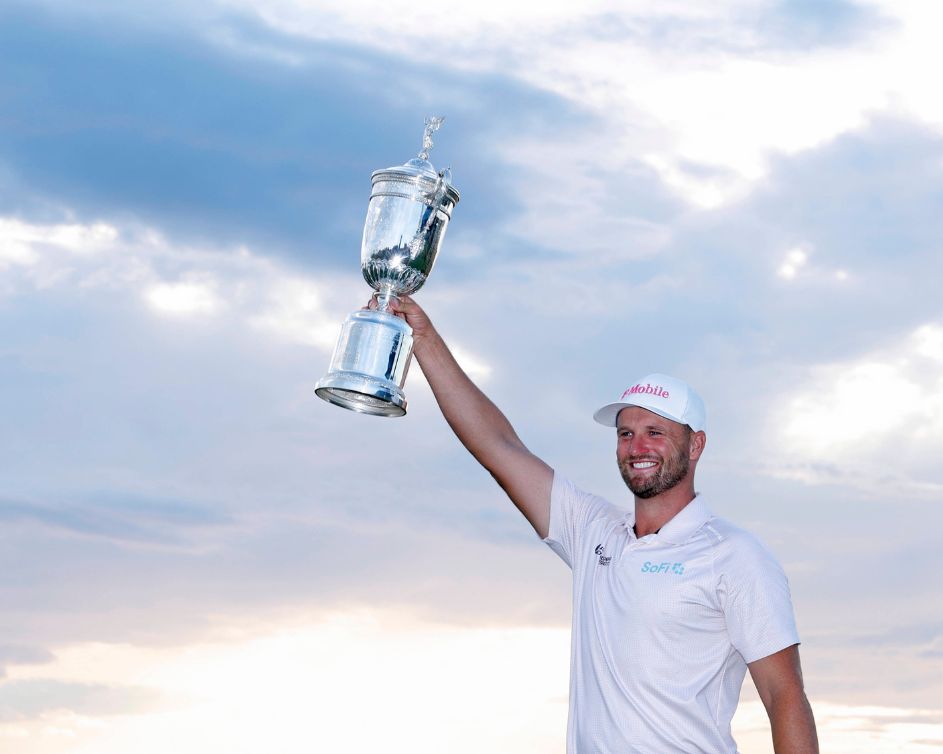

Wyndham Twice Over: Clark Wins His Second U.S. Open
From Villain to Champion: Wyndham Clark defies boos, a comeback by Sam Burns, and his own past.
It was 6:46 p.m. local time when Wyndham Clark stopped his final putt of the day nine inches from the hole, sank the tap-in, and threw his arms in the air. The crowd on the 18th hole at Shinnecock Hills reacted with restraint. Those who had expected to experience the typical celebratory atmosphere of a U.S. Open saw instead a quiet, almost defiant sigh of relief—both from the winner and from the few in the crowd who were rooting for him that Sunday.
Wyndham Clark is a U.S. Open champion for the second time. With a total score of 4-under-Par 276 (64–69–70–73), the 32-year-old from Colorado won the 126th edition of America’s national championship at Shinnecock Hills Golf Club in Southampton, New York, by one stroke over Sam Burns. It was the ninth wire-to-wire victory in the tournament’s history—and one of the most dramatic.
Shinnecock Hills, the classic links course on Long Island about a mile from the Atlantic Ocean, hosted the U.S. Open for the sixth time. The par-70 course, stretching 7,440 yards, was, as usual, considered merciless: In the five previous U.S. Opens held at this venue, only three players had finished the tournament under Par. Clark is now one of them—with 276 strokes, which exactly matches the record set here by Retief Goosen in 2004.
The winner’s check was for $4.5 million out of a total purse of $22.5 million.
See the final 2026 U.S. Open leaderboard here.
WIRE-TO-WIRE FOR WYNDHAM! 🏆 🏆 pic.twitter.com/k7kvzfXzTS
— U.S. Open (@usopengolf) June 21, 2026
How the Lead Developed
Clark teed off at the most favorable time of the tournament: A fog delay on Thursday morning pushed back all tee times, allowing him to take on a course that is otherwise unforgiving during a rare moment of calm winds. He capitalized on the opportunity—his 64 in the opening round was the lowest round ever played at the U.S. Open at Shinnecock Hills. With a solid 69 and a 70 on the following days, Clark further extended his lead. After 54 holes, he stood at 7 under Par—also a record for Shinnecock Hills—and held a six-stroke lead over his closest pursuers, including world No. 1 Scottie Scheffler.
From Villain to Champion—The Backstory
To understand what this victory means, you have to go back a year.
Wyndham Clark had won his first major title in 2023—a surprise triumph at the U.S. Open at the Los Angeles Country Club, where, as an underdog, he left Rickie Fowler and Rory McIlroy in his wake. What followed was a gradual decline—not so much on the course as in the public eye.
In 2025, the troubles mounted. At the PGA Championship, Clark threw a club and publicly apologized for it. A few weeks later at the U.S. Open in Oakmont, he missed the cut—and, in his frustration, kicked in the doors of two 121-year-old lockers. A photo of the damage circulated on social media and instantly turned Clark into a persona non grata in American golf. Oakmont barred him from the club until he paid the repair costs, made a donation to a charity of the club’s choosing, and completed anger management counseling.
Clark initially disappeared from the public eye. Only gradually did he reemerge—with apologies that some felt were too late and too half-hearted, and with a newfound mental stability that he attributed primarily to his longtime mental coach, Julie Elion. The turning point in his career came in May 2026: At the CJ Cup Byron Nelson in Dallas, Clark finished the final round with a 60 and won with a total of –30. Four weeks later, he was at Shinnecock Hills—first as a semi-dark horse, then as the leader after the first round, and finally as the winner.
“What happened last year at the U.S. Open was the wake-up call that told me: Hey, wake up, get back to who you are,” Clark said at the winners’ press conference. “I made mistakes. I learned a lot from them, and it brought me back to who Wyndham Clark is.”
Video highlights of the 2026 U.S. Open
The Final – 18 Holes Between Triumph and Humiliation
The Starting Point
Clark entered the final day of the tournament with a lead that looked comfortable on paper. A six-stroke lead at the U.S. Open—that had been enough to win 20 out of 20 times in the tournament’s history. The only exception in major history: Greg Norman at the 1996 Masters, who squandered an equally large lead. This parallel was brought up to Clark more than once in the days leading up to the final.
He himself admitted to waking up with a queasy feeling in his stomach.
A crowd against one man
When Clark and Scheffler teed off on the 1st hole at 2:24 p.m. local time, the atmosphere was immediately clear. Thousands of spectators sang a spontaneous “Happy Birthday” to Scheffler—the world No. 1 was celebrating his 30th birthday—and greeted Clark with a mixture of cool detachment and open displeasure.
What followed, according to observers, was one of the most extraordinary displays of fan behavior in the recent history of major tournaments. Clark heard shouts like “Crash and burn!” and “Get in the Bunker!”—the latter, according to Golf Channel reporter Smylie Kaufman, about 50 times over the course of the day. On the 4th hole, a fan shouted, “Don’t choke, buddy!” and was subsequently ejected from the course. Several other spectators followed suit as the round progressed. Fans cheered when Clark’s ball hit a Bunker and groaned when Scheffler missed a Putt.
Golf Channel analyst Brandel Chamblee commented on the events live on television: “I’ve never seen an American player booed like this on American soil. I’ve never seen anyone have to deal with this to such an extent in a major tournament.”
Scheffler, who was cheered on by the crowd, also spoke openly afterward about what he had observed: “Sometimes it can get a little too much when balls roll off the greens and you hear cheering. That was a bit too much for me. But at the end of the day, it says a lot about Wyndham—how he handled not only this golf course but also the crowd today.”
Mental coach Julie Elion, who has been working with Clark since his first major victory, briefly left the action after the eighth hole and retreated to the clubhouse. “I’ve seen a lot of bad behavior in 25 years, but never anything like this,” she said after the round.
Clark himself handled it with a mix of gallows humor and disciplined focus. Every time one of the few fans clapped for him, he joked with his caddie, Dave “Big Wave” Pelekoudas: “Oh, there’s someone who likes me.” Elion had prepared him to immediately replace negative stimuli with positive thoughts—a strategy Clark had already used successfully in Los Angeles in 2023.
Pelekoudas, who repeated the same mantra with nearly every shot, kept Clark on track: “Stay in the process.”
The Jitters on the First Nine Holes
Despite all his mental preparation, Clark got off to a weak start. Bogeys on holes 2, 5, and 7—the last of which was a missed Par putt from just four feet, greeted by the loudest cheer of the day from the crowd—left him at three over Par on the front nine. He turned after 38 strokes without having recorded a single Birdie.
While Clark struggled, Sam Burns was on fire three groups ahead of him. The 29-year-old from Louisiana, who had started seven strokes back, shot an impressive 32 (–3) on the front nine. With Birdies on holes 1, 3, 5, and 8—the last of which was a spectacular 50-foot Putt—he fought his way up to –4. When Clark bogeyed the 7th hole at the same time, the gap shrank to a single stroke. What had looked like a formality in the morning was suddenly an open tournament.
Scheffler, who was in the final group and theoretically should have been the biggest threat, never found his rhythm. A Bogey on the first hole, a Birdie on the par-5 fifth, but hardly any momentum. He never got closer than three strokes to Clark.
The Turning Point
The decisive chapter began on the 10th hole. Clark hit his tee shot 347 yards, leaving him just 61 yards from the hole. He played a controlled Wedge shot that spun the ball to within four feet. He made the Birdie. His first stroke gain of the day, his first sigh of relief, and his lead was back to two strokes. Burns took a wrong turn on the 15th hole with a Bogey. The lead grew to three. But Burns responded immediately with a Birdie on the par-5 16th.
Then came the moment this final day needed to complete the picture. Clark hit his tee shot on the 16th hole into thick fescue grass—a “terrible lie,” according to on-course reporter Jim Mackay. Clark told his caddie he had the shot. He played the ball back onto the Fairway, hit his third shot to 24 feet behind the flag—and sank the Birdie putt.
Clark clenched his right fist, shouted “Let’s go!” and said afterward, “That was probably the loudest I’ve ever cheered for myself.” The lead was back to two strokes. Burns was sitting on the driving range at that point, waiting for a possible playoff.
The Finale on Holes 17 and 18
Clark made a mistake on hole 17—his tee shot landed 69 feet from the hole, his first putt came up six feet short, and his second missed. A three-putt Bogey. Lead: one stroke. Burns, who in the meantime had missed Birdie chances from 10 and 16 feet on the 17th and 18th greens—the latter of which left him collapsing to his knees—had given it his all. All Clark had to do on the 18th hole was finish strong.
His drive landed in the first-cut Rough to the right of the Fairway. His approach shot landed on the green, about 52 feet from the hole. Clark played a lag Putt that stopped just a few centimeters from the hole. Tap-in. Victory.
Clark in the History Books
With this triumph, Clark joins a small, select group. As the ninth wire-to-wire winner of the U.S. Open, he stands among a list that includes names like Tiger Woods (twice), Rory McIlroy, Ben Hogan, and Walter Hagen. The last wire-to-wire winner before him was Martin Kaymer in 2014 at Pinehurst.
Clark is now the 24th multiple winner of the U.S. Open—and the third consecutive Shinnecock champion to claim his second major title there, following Retief Goosen in 2004 and Brooks Koepka in 2018. The parallel with Goosen is particularly striking: Goosen won his first major in 2001 at Southern Hills, his second in 2004 at Shinnecock Hills—also three years after his first victory, also with 11 one-putt greens in the final round, and also with a total score of 276.
Clark outperformed the field in key statistical categories: He led the field in putts made from over 20 feet (five in total) and saved 16 of 24 missed greens in regulation—ranking third among all competitors. A statistic that shows just how much this victory was based on mental fortitude and short-game strength, rather than flawless ball-striking.
The Challengers
Sam Burns posted the most impressive final round of the day. Starting seven strokes behind, he had become a genuine title contender—a feat last achieved in U.S. Open history by Arnold Palmer in 1960 (seven strokes back, Cherry Hills) and Johnny Miller in 1973 (six strokes back, Oakmont). His 67 was good for a solo second-place finish—his best major result and his third consecutive top-10 finish at the U.S. Open. At the press conference, Burns was visibly moved—partly because of the date. “Just to appreciate the significance of this moment and to know what this memory could have been like—that would have been truly special,” he said of Father’s Day, which he spent with his two-year-old son, Bear. He summed it up fairly, though: “I don’t think I lost the tournament today. I gave it my all.”
Tom Kim was one of two qualifiers in the field who earned an exemption to the next U.S. Open. The three-time PGA Tour winner, who had to go through the 36-hole qualifying round after dropping to No. 141 in the world rankings, finished the tournament in a tie for third place (–1, 279) , thereby securing his spot for the 2027 U.S. Open at Pebble Beach.
Scottie Scheffler failed to live up to the day’s narrative. The world No. 1, who was heading toward his 30th birthday and a potential Career Grand Slam —with only the U.S. Open remaining—was lackluster for long stretches. A Bogey on the first hole set the tone, and his Putter—which had been unreliable all week—regularly failed him in the final round as well. He finished at +1 (71) and tied for fourth place with J.T. Poston and Keith Mitchell, four strokes behind Clark. At least he was able to congratulate the winner with genuine respect: “He had nerves of steel out there. He’s a very underrated scrambler.”
Keith Mitchell made a small statistical footnote: He finished all four rounds with a 70—the first player to do so since Curtis Strange at the 1994 U.S. Open in Oakmont, which was played as a Par-71 course at the time. At Shinnecock Hills, a par-70 course, this is even more remarkable.
Rory McIlroy was never really in contention for the title. He briefly raised hopes on Saturday when he worked his way to 2 under on the front nine—but the back nine proved to be his Achilles’ heel. He finished the tournament at 6 over. “I fell apart. I shot myself out of the tournament,” he said after the round.
Team Clark—the people behind the victory
Wyndham Clark’s comeback would have been unthinkable without a strong support system. At the center is Julie Elion, one of the most renowned mental coaches in professional golf with 25 years of experience. Elion had already been working with Clark before the 2023 victory—her method: using negative stimuli as triggers to elicit positive reactions. Before the tournament, she gave Clark a mantra to take with him: “It’s not about what happens to us; it’s about how we react to it. This is your rodeo! You create your own inner world of confidence and joy.” Clark consistently applied this approach throughout the round.
Caddie Dave “Big Wave” Pelekoudas provided verbal mental support: With nearly every shot, he reminded Clark to stay in the moment. A new Ping Mallet putter, which Clark had introduced just before the tournament, proved to be a lucky choice—he ranked fourth in the field in putting for the week.

The Father’s Day Moment
When Wyndham Clark was greeted by a crowd of support staff, friends, and officials after his final tap-in, he was looking for one specific man. He found him— Randall Clark, his father, a former professional tennis player, who had booked a direct flight from Denver to New York overnight from Saturday to Sunday to surprise his son.
It was the first time Randall Clark had witnessed his son’s victory on the PGA Tour in person. Health issues had prevented him from doing so on previous occasions—including his son’s first U.S. Open triumph in 2023. The embrace on the 18th green at Shinnecock Hills, on Father’s Day, was correspondingly long.
The emotional context goes back even further. Clark’s mother, Lise Clark, a former Miss New Mexico, died in 2013 after a battle with breast cancer. Clark was 19 years old at the time. Her death shaped not only his character but also his long journey to the Tour—it took 134 starts before he finally secured his first victory at the age of 29.
“He’s never been there for any of my wins. But to win here now, on Father’s Day of all days—it’s just incredible,” Clark said at the press conference. “This isn’t just my win. It’s a win for my entire team.”
Outlook
It remains to be seen whether the victory will permanently change Clark’s image. He himself hopes so: “I really hope this closes the door on that. I’m glad I stuck with it. But today—today is my day.”
The next U.S. Open will be held June 17–20, 2027, at Pebble Beach Golf Links in California. Scottie Scheffler, who has yet to complete his Career Grand Slam, will likely be the top favorite there once again. Wyndham Clark will be there as a two-time U.S. Open champion—and this time, perhaps with the home-field advantage of public support.
Brandname
Title will go here and can run on two lines
Brandname
Title will go here and can run on two lines

Brandname
Title will go here and can run on two lines
Brandname
Title will go here and can run on two lines
Brandname
Title will go here and can run on two lines
Brandname
Title will go here and can run on two lines
Brandname
Title will go here and can run on two lines
Brandname
Title will go here and can run on two lines
Brandname
Title will go here and can run on two lines
Brandname
Title will go here and can run on two lines
Release date
22 Jun 2026
photos
Wyndham Clark wins his second major golf title at the 2026 U.S. Open. (Photo: Imago / UPI Photo)