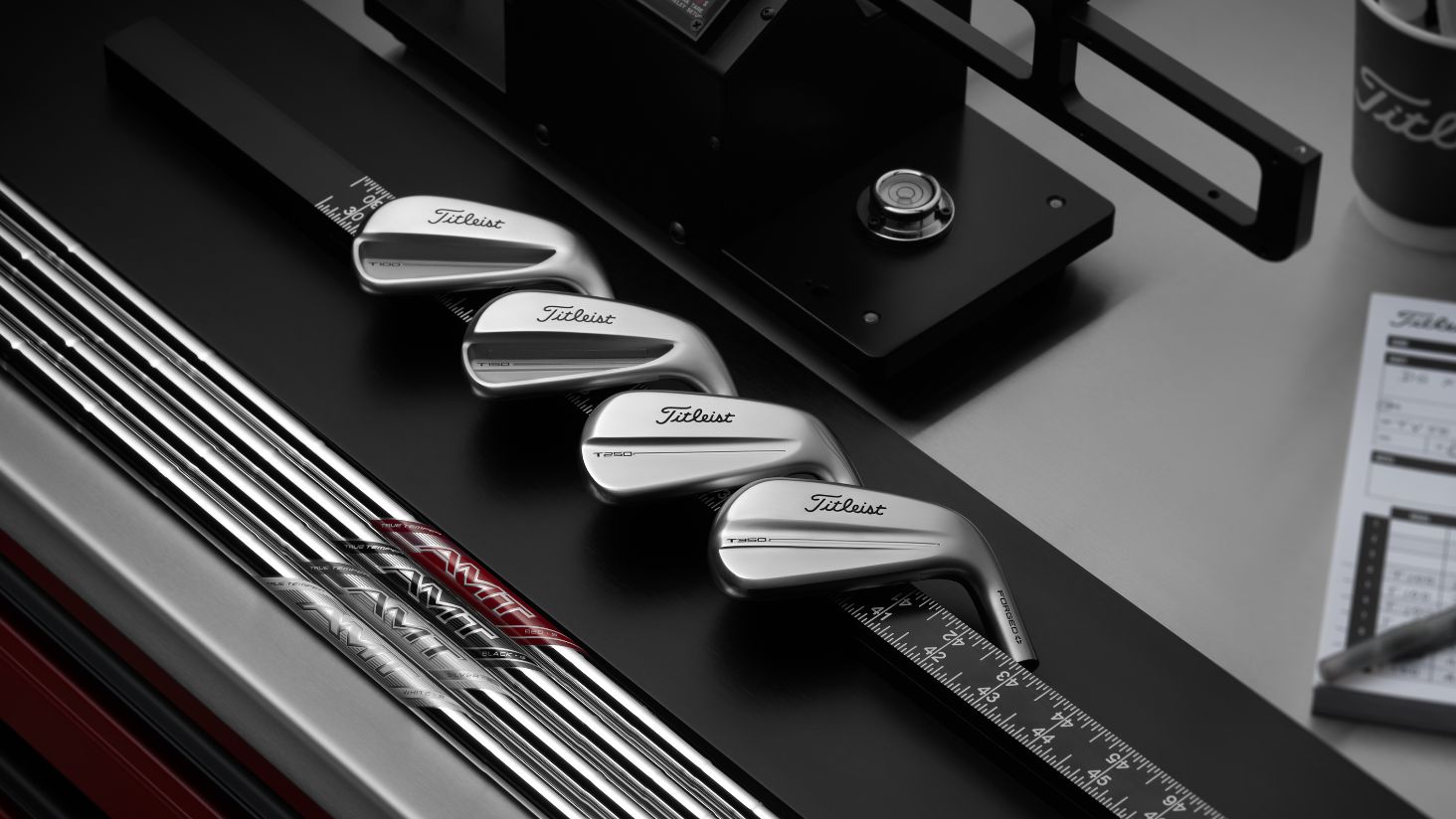
Titleist T-Series Irons: T100, T150, T250, and T350 Explained
Titleist T100, T150, T250, or T350—which iron is right for you? A comprehensive overview of all models, technologies, and fitting tips.
For decades, Titleist has set the standard in iron design—from classic Blades to precise Players irons to modern game-improvement models with maximum forgiveness. The current T-Series 2025 is the most consistent evolution of this tradition: four models, a shared design philosophy, and a clear answer to the question of which Iron suits which type of player.
Titleist – The World’s Most-Played Iron Brand
Titleist has been the most-played iron brand on the PGA Tour in 21 of the last 22 seasons—including the last 12 seasons in a row. On the DP World Tour, the brand has even held the top spot for 16 consecutive seasons. Since its introduction in 2019, the T100 has been the most-played individual iron model on the PGA Tour—a record that is second to none.
What does this mean for amateur golfers? The technologies—developed through direct feedback from the world’s best ball-strikers and tested at the Tour level—are immediately incorporated into the models available at golf retailers. Anyone who plays a Titleist T-Series iron benefits from the same development philosophy that players like Ludvig Åberg, Jordan Spieth, and Russell Henley rely on every day.
How do you pronounce “Titleist” correctly? Find out here.
The Titleist T-Series – An Overview
The T-Series follows a clear design philosophy that Titleist refers to as the “Three D’s ”:
- Distance Control – Consistent Distance Control: Each iron is designed to deliver the same distance every time
- Dispersion Control – Tight Scatter: Even off-center hits should stay on course
- Angle of Descent – Optimal landing angle: The ball should land on the green at a steep enough angle to stop
These three principles serve both as a fitting philosophy and as a guideline for product development. They are the reason why T-Series irons aren’t just “long”—they’re reliably long, with controlled ball flight and high consistency.
Another feature of the T-Series: It is designed from the ground up for blended sets. About 80% of Titleist Brand Ambassadors on the PGA Tour play sets consisting of at least two different T-Series models—such as the T100 in the short Irons for maximum control and the T250 in the long Irons for more height and speed. All models are visually and technically coordinated to ensure a seamless transition between the clubs in the bag.
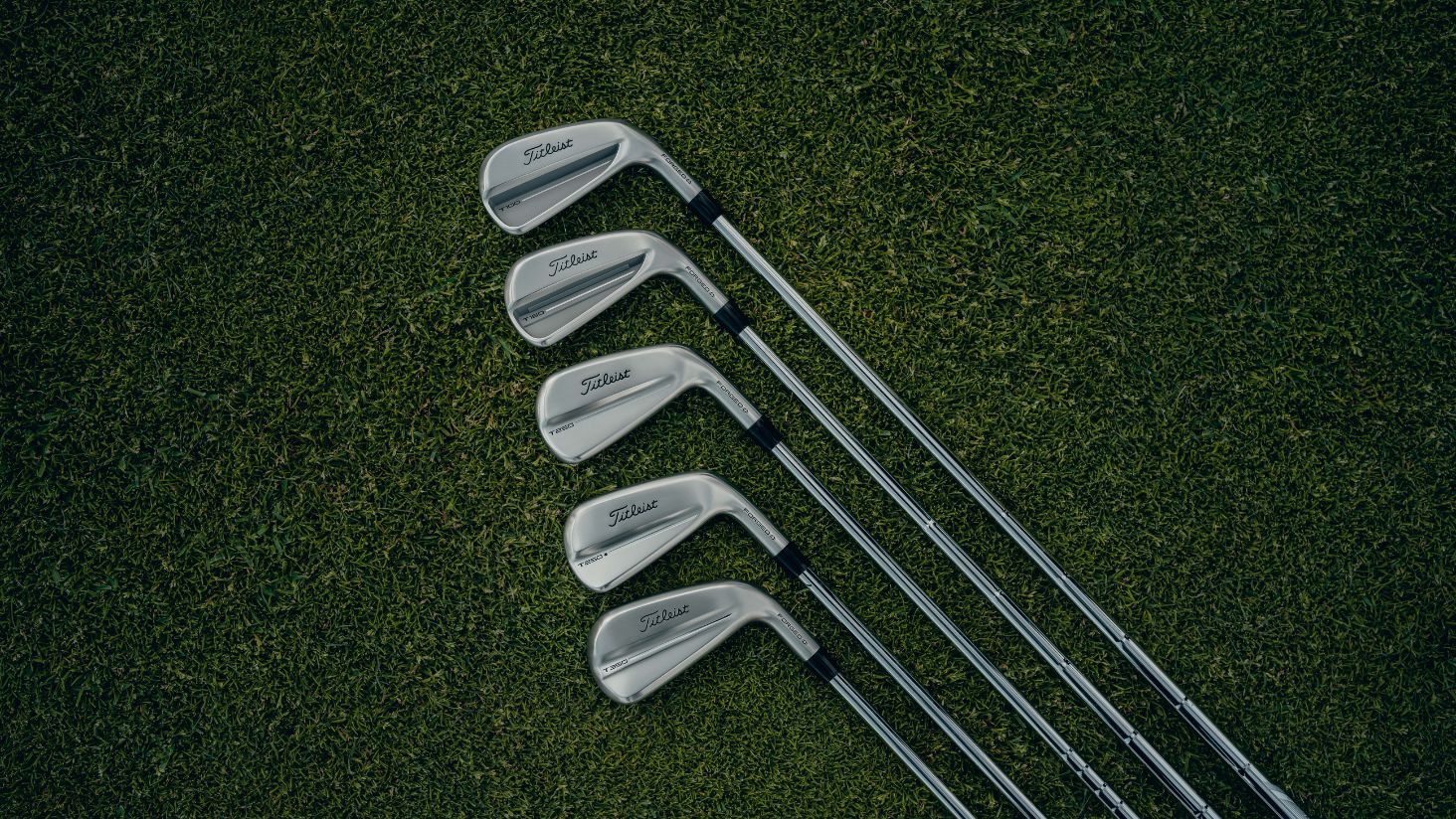
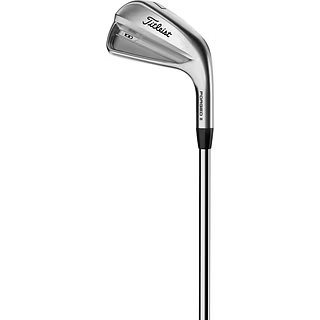
The current T-Series includes four main models: T100, T150, T250, and T350 —supplemented by the T250 Launch Spec for players with moderate swing speeds.
Brandname
Title will go here and can run on two lines
Brandname
Title will go here and can run on two lines
A Closer Look at the Latest 2025 T-Series Irons
Titleist T100 – The modern Tour iron
The T100 is the iron most trusted by the world’s best players—and has been the most played model on the PGA Tour without interruption since 2019. It’s crafted as a forged, multi-material Iron with a compact profile, thin topline, and minimal offset—a classic Players iron that instantly inspires confidence at address.
Core Technologies:
- Split High-Density Tungsten: Tungsten weighting with 2,000°F brazing technology for precise CG positioning—more stability and trajectory control
- Variable Face Thickness (VFT): In the 3- through 7-irons, the VFT design ensures consistent ball speeds even on slightly off-center hits
- Muscle Channel (3- and 4-irons): Lowers the center of gravity in the long irons, improving launch angle and flight height—one of the most significant improvements over the previous generation
- Progressive Grooves: Steeper, more angular grooves in the mid- and short Irons (7-iron through PW) stabilize spin rates from the Rough and in wet conditions
- Variable Bounce Sole: Improved sole geometry for faster, cleaner glide through the grass
The T100 is the iron of choice for Ludvig Åberg, Russell Henley, Wyndham Clark, and Jordan Spieth. Justin Thomas and Billy Horschel use it at the top end of their mixed sets.
Lofts: 3-iron (20°), 4 (23°), 5 (26°), 6 (29°), 7 (33°), 8 (37°), 9 (41°), PW (45°), W (49°)
Recommended for: Low-handicap players (approx. 0–12) who prioritize precision, feel, and control over maximum forgiveness
Where are Titleist golf clubs manufactured? Find out here.
Titleist T150 – The Faster Players’ Iron
The T150 is positioned as the faster players’ iron: It shares the same core technology as the T100 but offers steeper lofts, higher ball speed, and a higher launch—all within a slightly larger yet still compact profile that inspires confidence at address.
The key difference from the T100: The Muscle Channel is featured on the T150 starting with the 7-iron, resulting in a lower center of gravity across the entire set and allowing more players to benefit from the increased launch height. The T150’s lofts are two degrees steeper than those of the T100—enabling more distance without compromising feel or appearance.
Core Technologies:
- The same VFT and progressive groove technology as the T100
- Improved Muscle Channel starting with the 7-iron (instead of the 3-iron on the T100)
- Split high-density tungsten & 2,000°F brazing technology
- Variable Bounce Sole
Players who use T150 irons include Will Zalatoris (T150 as the primary iron in his set) as well as Byeong-Hun An and Aldrich Potgieter (T150 at the top end of their mixed sets).
Aldrich Potgieter won the Rocket Classic—his first start with the new T-Series set consisting of T150 (4-5 Irons) and T100 (6-9 Irons). It was the first worldwide tournament victory for the new T-Series generation.
Lofts: 3-iron (19°), 4 (22°), 5 (25°), 6 (28°), 7 (32°), 8 (36°), 9 (40°), PW (44°), W (48°)
Recommended for: Players with medium to low handicaps (approx. 5–18) who want to combine precision and feel with more speed and a higher launch
Titleist T250 – The Redefined Players’ Distance Iron
The T250 is the biggest new addition to the 2025 T-Series—and it’s not without reason that it comes with a new name. It replaces the previous T200 and hasn’t simply been updated— it’s been completely redesigned: featuring a new all-steel construction that hides cutting-edge Performance technology beneath a clean, classic exterior.
The T250 features a wider sole and thicker topline than the T100 and T150—which instills additional confidence at address without straying from the classic Players iron DNA of the T-Series. Under the hood is a powerful combination of technologies that delivers noticeably more speed, launch, and forgiveness—especially with the long irons.
Core Technologies:
- Forged L-Face with V-Taper Design: Increases ball speed and launch—especially on off-center and low-contact shots
- Enhanced Max Impact Technology: Delivers more consistent distance across the entire clubface
- Split High-Density Tungsten: Optimized CG position for a higher launch and greater stability
- Progressive Grooves: Spin consistency across the entire set
Justin Thomas immediately added a T250 4-iron to his bag at the Memorial Tournament; Wyndham Clark followed suit with T250 3- and 4-irons.
Standard Lofts: 2-Iron (18°), 3 (20°), 4 (22°), 5 (24°), 6 (27°), 7 (30.5°), 8 (34.5°), 9 (38.5°), PW (43°), W (48°)
T250 Launch Spec (new): For players with moderate swing speeds who need more launch and height. Lighter head weight (–6 g) and steeper lofts (7-Iron: 35° instead of 30.5°) for effortless high ball flight and more stopping power on the green. Available starting with the 5-Iron (27°): 5 (27°), 6 (31°), 7 (35°), 8 (39°), 9 (43°), PW (47°), W (52°)
Recommended for: Mid-handicap players (approx. 15–28) looking for distance and forgiveness in a visually appealing Players club. T250 Launch Spec for moderate swing speeds and players who need more launch height.
Discover Titleist’s latest GTS driver series.
Titleist T350 – The Ultimate Game-Improvement Iron
The T350 is the most forgiving and longest-hitting model in the T-Series—and is designed for golfers seeking maximum support in achieving consistent distances and high ball flight. Like the T250, it features an all-steel construction that creates a visually harmonious set—even in mixed set configurations.
Core Technologies:
- L-Face with Multi-Zone VFT Design: Drives a high launch on low-hit shots and generates ultra-fast ball speeds across the entire face
- Enhanced Max Impact Technology: More consistent distance and tighter dispersion
- Split High-Density Tungsten: Perimeter weighting for an optimized center of gravity, more launch, stability, and consistency
- Progressive Grooves: Spin consistency in all conditions
“The T350 has the largest clubhead, the fastest face, and the lowest CG of our entire T-Series. It is consistently engineered for maximum distance and stability.” — Marni Ines, Director of Iron Development, Titleist
Lofts: 4-iron (20°), 5 (23°), 6 (26°), 7 (29°), 8 (33°), 9 (38°), PW (43°), W48 (48°), W53 (53°)
Recommended for: Players with higher handicaps (approx. 20+) who benefit from maximum forgiveness, a high ball flight, and consistent distance
Is a Mini-Driver right for you? Learn more about the Titleist GTS300 Mini-Driver here.
Comparison Chart: Which Titleist T-Series model is right for you?
All four T-Series models share the same design philosophy—but differ specifically in profile, technology, and target audience:
| T100 | T150 | T250 | T350 | |
|---|---|---|---|---|
| Construction | Forged Multi-Material | Forged | Solid Steel | Solid Steel |
| Profile | Compact, Tour | Slightly Larger, Compact | Wide, Spacer | Large, GI |
| 7-iron loft | 33° | 32° | 30.5° | 29° |
| Ball Launch | Precise, controlled | Faster, higher | High, consistent | Maximum height |
| Forgiving | Medium | Medium–High | High | Maximum |
| Recommendation (Handicap) | 0–12 | 5–18 | 15–28 | 20+ |
| Tour Players | Åberg, Spieth, Henley | Zalatoris, Potgieter | Thomas, Clark | — |
Note: This table is intended as a general guide. Whether the T100, T150, T250, or T350—or a combination thereof—is the right choice can be determined most reliably through a professional fitting.
Titleist Utility Irons: T250•U and U•505
Utility irons occupy a very specific place in the bag: They serve as the bridge between long irons and Fairwaywoods—designed for high trajectories, fast ball speeds, and maximum stability. Titleist has been the most-played Utility iron brand on the PGA Tour for years: Through the 2025 U.S. Open, 60% of all utility irons played on the PGA Tour were from Titleist.
T250•U – The Compact Utility Iron
The T250•U is based on the exact same construction and technology as the T250 iron—with an identical profile shape and loft progression. It is the more compact of the two utility models and is designed for players looking for a controlled, fast Utility Iron with a players’ profile at the top end of their mixed set.
Technologies: Forged L-Face, V-Taper Design, Max Impact Technology, Split High-Density Tungsten, Progressive Grooves – identical to the T250
Lofts: 2-Iron (18°), 3-Iron (20°), 4-Iron (22°)
Recommended for: Players looking for a Utility Iron with a classic Players profile who want to seamlessly integrate it into a T-Series set
U•505 – The High-Launch Utility Iron
The U•505 is the larger, higher-launching of the two Utility models—and has been equipped with a progressive profile for the new generation: For the higher-lofted Irons (1- and 2-Irons), wider soles and lower clubfaces ensure a flatter, faster angle of attack; for the lower-lofted Irons (3- and 4-Irons), the sole narrows and the clubface rises—allowing for greater control and playability.
These design adjustments to the 3- and 4-irons were directly inspired by Tour pros and make the U•505 one of the most versatile Utility Irons on the market.
Core Technologies:
- Forged L-Face with V-Taper design for high ball speed and launch
- Enhanced Max Impact technology for consistent distance and spin
- Split High-Density Tungsten for optimized CG position
- Variable Bounce Sole for smooth glide through the grass (inspired by Vokey design)
Players with the U•505 in their bags include Byeong-Hun An (1-Iron) and Cameron Davis (3-Iron).
Lofts: 1-Iron (16°), 2-Iron (18°), 3-Iron (20°), 4-Iron (22°)
Recommended for: Players looking for maximum launch, high ball speed, and forgiveness in a more generous profile at the top end of their set
Titleist Pro V1 vs. Titleist Pro V1x—Which Titleist golf ball is right for you?
Limited Editions: T-Series Black Vapor & Oil Can
If you value not only performance but also aesthetics in the T-Series irons, you’ll find attractive alternatives in two limited editions:
T-Series Black Vapor (July 2026): The latest Black Edition features a Titanium Carbide Vapor finish, which is applied to the clubhead using a vapor deposition process. The result is an exceptionally durable, stain-resistant, matte black finish—available on the T100, T150, T250, and T350 in both right- and left-handed models. Onyx-look shaft options and Golf Pride Tour Velvet Blackout grips complete the look.
T-Series Oil Can (April 2026): A warm copper finish achieved through a PVD process—also available on the T100, T150, T250, and T350. Originally developed for Vokey wedges, this finish reduces glare and enhances the visual appeal at address. Matching copper-colored Golf Pride Z-Grip Full Cord grips are included.
Both editions can be ordered individually for mixed sets. Learn more about the Titleist T-Series Black Vapor Irons here.
Blended Sets – Why Pros Rarely Play a Uniform Iron Set
One of the most striking features of the T-Series is its design as a blended set family: About 80% of Titleist Brand Ambassadors on the PGA Tour play sets consisting of at least two different T-Series models. The logic behind this is simple and compelling.
Long irons (2–5) have different requirements than short irons (7–PW): In the long game, launch angle, ball speed, and forgiveness are key. In the short game, spin control, precision, and feel dominate. Using a single iron model throughout the entire set is therefore rarely the optimal solution.
Real-world examples:
- Will Zalatoris: T150 5–9 Irons, T200 4-Iron, T350 3-Iron
- Justin Thomas: T250 4-iron, T100 5–9-irons
- Byeong-Hun An: U•505 1-iron, T250 3-iron, T150 4–5-irons, T100 6–9-irons
For amateur golfers, this means that a professional fitting is especially worthwhile when it comes to Irons—because the question isn’t just which model to choose, but which combination of models will produce the optimal distance gapping, flight height, and stopping power across the entire set.
Titleist Iron Fitting at ALL4GOLF
The Three D’s—Distance Control, Dispersion Control, and Angle of Descent—are not only a guiding principle in development but also the core of every Titleist iron fitting. Specifically, Titleist fitters look for the following benchmarks:
- Ball speedgaps: Ideally, a 5 mph difference between each Iron
- Consistent Flight Heights: Same apex from long Irons down to the 7-iron
- Landing angle: Long irons should not land flatter than the 7-iron
A fitting at ALL4GOLF can help you with this:
- Identify the right T-Series model—or the right combination of models
- Customize loft and lie (±2° loft in 1° increments, ±2° lie in 0.5° increments)
- Select the optimal shaft from a wide selection
- Configure a blended set consisting of two or more T-Series models, if needed
Schedule a fitting appointment with ALL4GOLF now
Previous generations: T200, AP1, AP2, and others
Titleist T200 (through 2024) and the 2023 T-Series
Anyone who has played a Titleist T200 so far was already well-equipped: The T200 was the Players Distance model of the previous T-Series (2023) and impressed with high ball speed, good launch, and a clean players’ profile. With the 2025 model update, the T200 was replaced by the completely redesigned T250 —featuring an improved all-steel construction, optimized Max Impact technology, and an even more consistent ball flight across the entire clubface. Anyone switching from the T200 to the T250 will notice the improvement.
Titleist AP1, AP2 & 735 CM – the origins of the T-Series
Before the T-Series debuted in 2019 with the T100, it was the AP models that defined Titleist’s iron lineup. The AP2 (Titleist Performance Iron, introduced in 2008) is still considered one of the most influential player’s irons in golf history—featuring a forged body, tungsten weighting, and precise control for better players. It is the direct predecessor to today’s T100.
The AP1, as a more forgiving model with steeper lofts, appealed to a broader audience—similar to the current positioning of the T150 and T250.
Going even further back is the Titleist 735 CM —a classic iron in the tradition of hand-forged Blades that still holds a firm place in golf history.
For amateur golfers who still have AP1 or AP2 irons in their bags: The current T-Series outperforms its predecessors in nearly every measurable aspect—it’s worth making the switch, ideally in combination with a professional fitting.
FAQ – Frequently Asked Questions About Titleist Irons
Are Titleist T100 irons blades?
No. The T100 is not a classic Blade, even though it resembles one visually. It is a forged, multi-material Iron with a dual-cavity construction, tungsten weighting, and VFT design—in other words, a modern Players iron with significantly more technology under the hood than a classic Blade. The T100 offers Tour-level precision and feel, but with noticeably more forgiveness than a pure Blade.
What’s the difference between the T100 and the T150?
Both models are based on the same forged platform and share many technologies. The key differences: The T150 has steeper lofts (2 degrees steeper than the T100), a Muscle Channel starting with the 7-iron (compared to the 3-iron on the T100), and a slightly larger profile. The result is greater ball speed and a higher launch—while still maintaining a compact look. The T100 is the precision model for very skilled players; the T150 offers the same Tour-level performance with a bit more forgiveness.
What handicap range is the Titleist T200 suitable for—and what is its successor?
The Titleist T200 was designed as a Players Distance Iron for golfers with handicaps ranging from approximately 10 to 25. Since 2025, its direct successor has been the Titleist T250 —featuring an improved all-steel construction, optimized Max Impact technology, and even more consistent Performance. Those who have played the T200 will find the T250 to be a logical evolution of the same concept.
Are Titleist AP2 irons good for high-handicap players?
The AP2 was a classic players’ iron with an emphasis on precision and feel—and was therefore designed more for skilled players (handicap approx. 0–15). If you have a high handicap and need more forgiveness, you’re much better off with the current T250 or T350: both offer more modern technology, more launch assistance, and significantly greater forgiveness than the AP2.
What is a blended set from Titleist?
A blended set combines different T-Series models in the same bag—for example, the T250 in the long Irons (3–5) for more launch and forgiveness, and the T100 or T150 in the short Irons (6–PW) for maximum control and feel. Since all T-Series models are visually and technically coordinated, the transition within the bag is seamless. About 80% of Titleist Brand Ambassadors on the PGA Tour play such blended sets.
Is Titleist the most-played Iron brand on the PGA Tour?
Yes. Titleist has been the most-played Iron brand on the PGA Tour in 21 of the last 22 seasons—including the last 12 seasons in a row. Since its introduction in 2019, the T100 has also consistently been the most-played individual iron model on the Tour. Titleist has also led the statistics on the DP World Tour for 16 consecutive seasons.

Brandname
Title will go here and can run on two lines
Brandname
Title will go here and can run on two lines
Brandname
Title will go here and can run on two lines
Brandname
Title will go here and can run on two lines
Brandname
Title will go here and can run on two lines
Brandname
Title will go here and can run on two lines
Brandname
Title will go here and can run on two lines
Brandname
Title will go here and can run on two lines
Release date
31 Jul 2026
photos
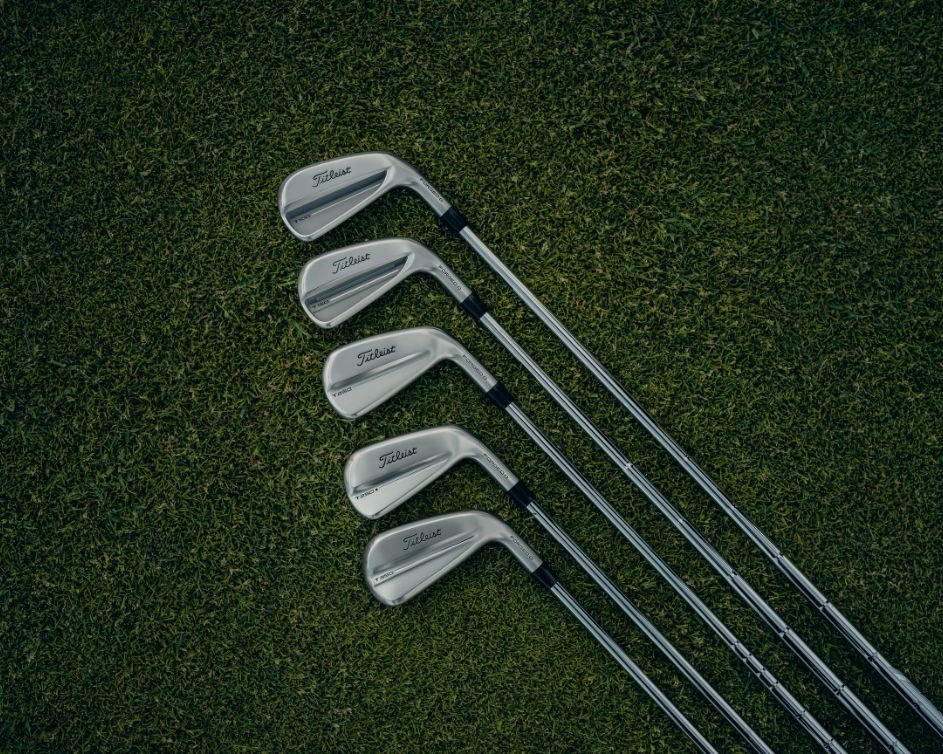
Titleist's current T-Series includes four different Irons designed for a variety of needs—find out here which Iron is right for you. (Photo: Titleist)