

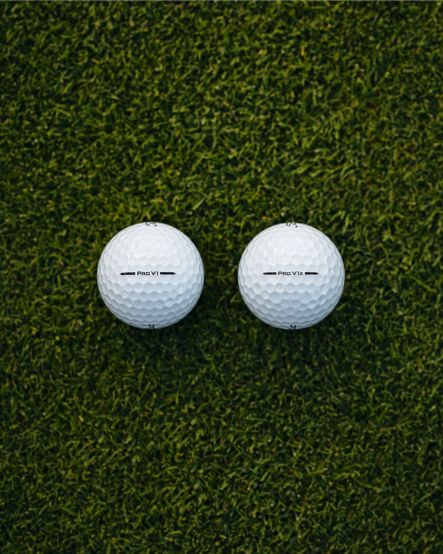
Titleist Pro V1 vs. Pro V1x – Which Ball Is Right for Your Game?
Pro V1 or Pro V1x? We explain the differences in spin, flight path, and feel—using Tour data from the 2025 season.
The Titleist Pro V1 celebrated its 25th anniversary in 2025—and has been the world’s most-played golf ball for a quarter-century. Its sister model, the Pro V1x, followed three years later. Together, these two balls dominate the world’s professional Tours like no other product in golf: During the 2025 PGA Tour season, 73% of all balls played were supplied by Titleist —and the Pro V1 and Pro V1x combined to win 26 of the 46 tournaments held.
But what exactly is the difference? And which ball suits your game? In this article, we answer exactly these questions—with technical facts, Tour data, and a clear buying recommendation.
Titleist Pro V1 vs. Pro V1x: At a Glance
| Feature | Pro V1 | Pro V1x |
|---|---|---|
| Construction | 3-piece (solid core) | 4-piece (dual core) |
| Compression | 98 (softer) | 108 (firmer) |
| Trajectory | Medium-high | High |
| Spin (Driver) | Low | Slightly higher |
| Spin (Irons/Wedges) | Low | Higher |
| Landing angle | Steep | Even steeper |
| Feel | Very soft | Soft-firm |
| Shell | Soft urethane elastomer | Soft urethane elastomer |
| Price per dozen | €64.99 | €64.99 |
Brandname
Title will go here and can run on two lines
Brandname
Title will go here and can run on two lines
What are the design differences between the Pro V1 and the Pro V1x?
Both balls share the same soft urethane elastomer cover and the same high-flex casing layer to enhance speed. The key difference lies in the core:
- The Pro V1 features a one-piece solid core —softer in overall compression, which creates a characteristically soft feel at impact.
- The Pro V1x features a two-piece dual core that produces a higher overall compression. This design allows for more precise spin control depending on the type of shot: lower spin on long game shots, higher spin with Irons and Wedges.
The principle behind this: A hard layer over a softer layer reduces spin on hard hits (Driver, Hybrid). A soft shell over a firmer casing layer increases spin on slower shots around the green. This so-called “spin slope” —the difference between long-game spin and short-game spin—is steeper on the Pro V1x than on the Pro V1.
The new 388-tetrahedron dimple design of the 2025 Pro V1 optimizes distance with a penetrating, consistent flight. The Pro V1x features the 348-tetrahedron dimple design, which is engineered for a higher ball flight with maximum consistency.
Discover the third model in the Titleist Pro V1 family, the Pro V1 Left Dash, here.

Pro V1 vs. Pro V1x: The Differences in Detail
When Putting
With a compression rating of 98, the Pro V1 feels noticeably softer than the Pro V1x (compression 108). In practice, however, the difference when putting is subtle—what many golfers perceive as “feel” is largely due to the sound they hear at impact. Both balls are available with Titleist’s pre-printed AIM alignment line.
With Wedges and the Short Game
This is where the most noticeable differences begin. The Pro V1x produces measurably more spin on pitches and chips—which can be an advantage on approach shots to firm greens or when the Pin is on the edge. The Pro V1 flies slightly higher on Wedge shots and lands at a steeper angle, so it also stops reliably—just in a different way.
With irons
The differences in iron play are present but subtle. The Pro V1x generates slightly more spin on iron shots and, due to its aerodynamics, tends to fly higher, which promotes a steeper landing angle and faster stopping on the green. The distance achieved is nearly identical for both balls.
With the Driver
Off the Tee, the Pro V1 and Pro V1x are most similar. Both balls deliver comparable ball speed, trajectory, and distance. An important note from Titleist: The ball that goes the farthest is always the one that’s fitted to you —not necessarily the Pro V1 or Pro V1x. An example from the professional ranks: Jake Knapp plays the Pro V1 because the ball naturally controls his high spin. Justin Thomas plays the Pro V1x because he needs more spin to maximize control.
Everything you need to know about a golf ball’s weight, size, and dimples.

Which one wins on the Tour? Pro V1 or Pro V1x?
The answer may surprise you: In the 2025 PGA Tour season, both models were virtually neck and neck.
- Pro V1: 14 wins —including six by Scottie Scheffler, who defended his No. 1 world ranking with the 2021 model of the Pro V1. Other winners: Harris English, Joe Highsmith, Viktor Hovland, Brian Harman, and others.
- Pro V1x: 12 wins by 12 different players, including Ludvig Åberg, Justin Rose, and Sami Välimäki with the current 2025 model.
Particularly noteworthy: Many Tour pros play older model generations of the Pro V1 or Pro V1x. Scottie Scheffler’s six victories came with the 2021 Pro V1—and Harris English claimed three more victories in 2025 using the even older 2017 Pro V1. This shows that Tour pros don’t necessarily opt for the latest model, but rather the one they feel most comfortable with.
Where are Titleist golf clubs and golf balls manufactured? Find out here.
Which Pro V1 ball is right for whom?
Titleist Pro V1—the right choice if you…
- prefer a very soft feel from the Tee to the green
- are looking for a medium ball flight with low, consistent spin
- have relatively moderate swing speeds (the softer core compresses more efficiently)
- don’t want to notice a difference in distance compared to the Pro V1x and simply prefer the softer feel
Titleist Pro V1x – the right choice if you…
- are looking for a higher trajectory and more spin on Iron and Wedge shots
- want the ball to stop quickly on the green (steeper landing angle)
- prefer a slightly firmer, more direct feel at impact
- enjoy hitting the ball low and letting it land with controlled spin
Important: Fitting trumps gut feeling
Titleist explicitly emphasizes that the longest and best ball is always the one that’s been fitted. A ball fitting—offered by Titleist itself and at many golf retailers—uses your individual swing data to determine which model is optimal for your swing speed, spin rates, and preferences.
Who owns Titleist? Find out here.
The Titleist Pro V1 2025: What’s new?
The current 2025 generation features a newly reformulated high-gradient core for both models, which enables both higher ball speed off the Driver and more spin with Wedges—in other words, a steeper spin slope than the previous generation.
Specifically, the 2025 generation offers:
- More speed off the Tee thanks to improved core chemistry
- Increased spin on approach shots for more control
- Optimized dimple designs for both models (Pro V1: 388 tetrahedrons, Pro V1x: 348 tetrahedrons)
- Over 90 quality checks for the Pro V1 and 120+ for the Pro V1x (dual-core)
Five weeks after the Tour launch at the Shriners Children’s Open in October 2024, both models had already secured four Tour victories.
Personalization and Customization
Both models are available with numerous personalization options:
- Enhanced Alignment: A pre-printed alignment aid that is over 65% longer than the standard side marking—for more precise aiming when Putting
- Custom Play Numbers: Numbers from 00–99 instead of the standard numbers 1–4
- Personalization: Text, logos, and custom designs via Titleist.com or golf retailers
- Colors: White and High-Optic Yellow
Discover the entire Titleist golf ball lineup here.
FAQ: Frequently Asked Questions About the Pro V1 and Pro V1x
What is the difference between the Titleist Pro V1 and Pro V1x?
The Pro V1 has a softer solid core (compression 98), flies at a medium-high trajectory, and offers maximum short-game spin with a very soft feel. The Pro V1x has a firmer dual core (compression 108), flies higher, generates more spin with Irons and Wedges, and lands steeper on the green.
Which ball flies farther—the Pro V1 or the Pro V1x?
Neither is generally longer. Titleist explicitly emphasizes: The ball that flies the farthest is always the one that’s been fitted to you. At slow swing speeds, the softer Pro V1 can provide marginally more distance because it’s easier to compress. At medium and high swing speeds, both balls fly nearly the same distance.
Which Titleist Pro V1 ball is right for me?
If you prefer a soft feel and a medium ball flight: Pro V1. If you’re looking for a higher ball flight, more spin with Irons and Wedges, and a slightly firmer feel: Pro V1x. If in doubt: get a ball fitting.
What does “Titleist ProV1” mean—is it the same as Pro V1?
Yes. “ProV1” or “Titleist ProV1” is the abbreviated version of the full model name “Pro V1.” It’s the same ball.
Is the 2025 Titleist Pro V1 better than the 2023 model?
Yes—the 2025 generation delivers measurably higher ball speed and a steeper spin slope, meaning more spin with Wedges while maintaining low spin with the Driver. However, many Tour pros deliberately play older models if they’re a better fit for their swing.
How many tournaments did Titleist win in 2025?
Titleist golf balls won 26 of the 46 PGA Tour tournaments held during the 2025 season—14 with the Pro V1 and 12 with the Pro V1x. 73% of all balls played on the PGA Tour were Titleist.

Brandname
Title will go here and can run on two lines
Brandname
Title will go here and can run on two lines
Brandname
Title will go here and can run on two lines
Brandname
Title will go here and can run on two lines
Brandname
Title will go here and can run on two lines
Brandname
Title will go here and can run on two lines
Brandname
Title will go here and can run on two lines
Brandname
Title will go here and can run on two lines
Release date
01 Oct 2026
photos
We're comparing the most popular golf balls: the Titleist Pro V1 and the Titleist Pro V1x. (Photo: Titleist)


