TaylorMade Spider Putters: All Models, Differences, and Buying Guide
The TaylorMade Spider putter is one of the most widely used tour putters worldwide. All models, differences, and buying tips.
No putter model is seen more often on the PGA Tour than the TaylorMade Spider putter. This isn’t just a marketing claim—it’s a statistic that shows up year after year in the Tour’s club statistics. Players like Rory McIlroy, Scottie Scheffler, Jon Rahm, and Dustin Johnson have won with various TaylorMade Spider putter models—at major championships, under immense pressure, on the fastest greens in the world.
So when you pick up a TaylorMade Spider golf putter, you’re not just holding a putter. You’re holding a tool that was developed and refined under the toughest conditions in golf.
At the same time, the Spider lineup has grown so extensive that choosing the right one can be a real challenge: Spider Tour, Spider Tour X, Spider ZT, Spider Torched Tour X—what’s really behind them? Which TaylorMade Spider Putter is right for you? And what sets a Putter priced at 360 euros apart from one costing over 600 euros?
This article provides answers—technical, clear, and free of sales hype.
The Spider DNA: What All Models Have in Common
Before we dive into the model families, it’s worth taking a look at what all Spider putters have in common. Over several generations, TaylorMade has developed a technical platform characterized by consistent refinement—rather than radical reinvention.
Mallet Construction with Spider Frame
The TaylorMade Spider putter is a Mallet putter in its purest form: a large, wide head with a distinctive open steel frame that shifts mass far outward. This construction isn’t a design gimmick, but is physically motivated: The farther the mass is from the axis of rotation, the higher the moment of inertia (MOI). A high MOI means the head twists less on off-center strikes—resulting in a more consistent roll, even when the ball isn’t struck perfectly in the center.
Pure Roll Insert
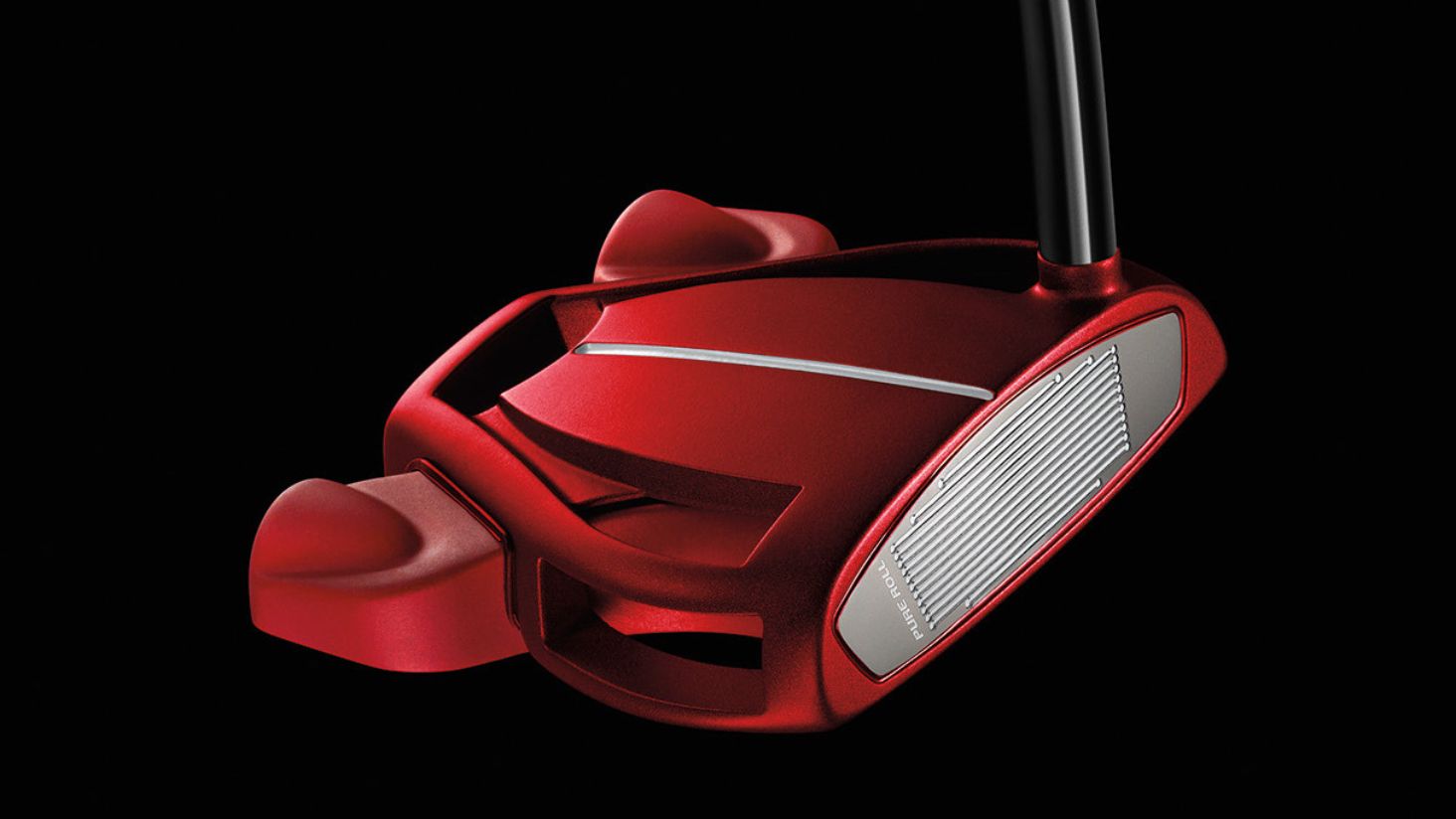
Almost all Spider models are equipped with the Pure Roll Insert: a laminated insert made of Surlyn and aluminum with 45-degree grooves on the face. These grooves overlay the natural glide effect that occurs upon contact between the club and the ball with an early forward rotation. As a result, the ball transitions more quickly from glide to roll mode—which leads to a more consistent and controllable ball path on fast greens.
True Path Alignment System
Most current Spider models feature a True Path alignment aid on the top—a system of colored lines designed to help golfers align the clubface precisely with the target line. In the ZT series, these lines have been milled directly into the steel as “Milled True Path” —a testament to the higher manufacturing standards of this line.
Brandname
Title will go here and can run on two lines
Brandname
Title will go here and can run on two lines
Who is a TaylorMade Spider Putter generally suitable for?
The Spider is not a one-size-fits-all putter. Its strengths really shine when:
- the player has a straight or slightly arched putting stroke,
- stability and consistency are prioritized over maximum feel,
- golfers benefit from a large, visually dominant head that instills confidence when aiming.
Players with a strongly arched stroke (high toe hang) typically opt for Blade putters. However, as we’ll see shortly, the TaylorMade Spider Putter also offers hosel variants with slightly more toe hang for slightly arched strokes. The differences between the models are real and relevant to the purchasing decision.
From 2008 to Today: The Evolution of the Spider
The history of the TaylorMade Spider is one of the most remarkable product stories in modern golf—a story that began with a simple design idea and, over more than 15 years and ten generations, has evolved into one of the world’s best-selling and most-played Putter lines.
2008: The Monza Spider—a Putter that changed everything
The first Spider was released in 2008 under the name Monza Spider. At the time, TaylorMade had designed a Putter that was consistently engineered for maximum MOI: an open steel frame with an aluminum core, with mass deliberately shifted far outward to the corners. The design was unconventional, almost provocative—at a time when Blade putters dominated the field.
TaylorMade projected sales of around 30,000 units for the first year. By the end of the year, that number had surpassed 200,000. The Monza Spider was a sales success that surprised no one more than the manufacturers themselves. The model celebrated its first Tour victory when J.B. Holmes won the 2008 FBR Open in a playoff against Phil Mickelson.
The Itsy Bitsy Spider—the foundation of the modern line
Based on Tour feedback, TaylorMade reduced the head of the Monza Spider by 20 percent, creating the Itsy Bitsy Spider. This slimmer, more compact shape was the decisive step toward today’s Spider design. Many elements that define the modern Spider—the head size, the frame structure, the hosel geometries—were established by the Itsy Bitsy Spider. It became one of the best-selling putters of its time and established the Spider line as a distinct product category.
2011: Ghost Spider—the White Revolution
TaylorMade had already launched a white Putter in 2010 with the Corza Ghost—thereby establishing an idea that viewed the game of putting from a new perspective: white as an alignment tool. The stark contrast between the white putter head and the green grass was intended to make it easier to perceive the target line.
In 2011, the logical next step followed: the Ghost Spider. The white finish struck a chord with many golfers—TaylorMade cited statistics at the time showing that 65 percent of all golfers were not properly aligned with the target when putting from twelve feet. The Ghost Spider was the answer. The 2012 update, the Ghost Spider S, replaced the basketball-style alignment system with a simple white center line on a black background—a simplification that finally brought the alignment debate into the mainstream.
Spider Tour Red and Tour Black – Tour Validation in Color
In the mid-2010s, TaylorMade focused on Tour validation of the Spider line. The Spider Tour Red was developed in close collaboration with Jason Day, who wanted a Putter in a very specific shade of red. TaylorMade’s product team worked through 15 different shades of red with Day before the final color scheme was finalized. The Spider Tour Red became the symbol of a new era: the Spider was no longer just a stable Mallet Putter—it was a Tour-level tool with its own distinct character. The TaylorMade Red Spider, as it is often called, remains highly sought after by collectors to this day. The Spider Tour Black followed as a technically identical, visually streamlined alternative.
2019: Spider X – the tenth generation
Ten years after the Monza Spider, TaylorMade introduced the Spider X in 2019 as the tenth generation of the line. The Spider X was larger than its predecessors, heavier, and—for the first time—equipped with the Pure Roll Insert as standard—the laminated Surlyn-aluminum insert that has since distinguished all Spider models. At the same time, TaylorMade introduced the True Path alignment system, which took the visual alignment aid to a new technical level. The Spider X quickly became the most successful model in the family—not least because Rory McIlroy adopted it as his Putter of choice.
Spider EX and Spider GT – Fine-Tuning and Customization
The Spider EX introduced the second generation of the Pure Roll insert, complemented by a softer shaft featuring Fluted-Feel technology for an improved feel at impact. The Spider GT paved the way for customization: Through the MySpider program, golfers could for the first time individually configure the color, finish, insert, and hosel—a step that transformed the Spider from a Tour Putter into a customizable premium product.
Current: Spider Tour Series and Spider ZT—the latest generation
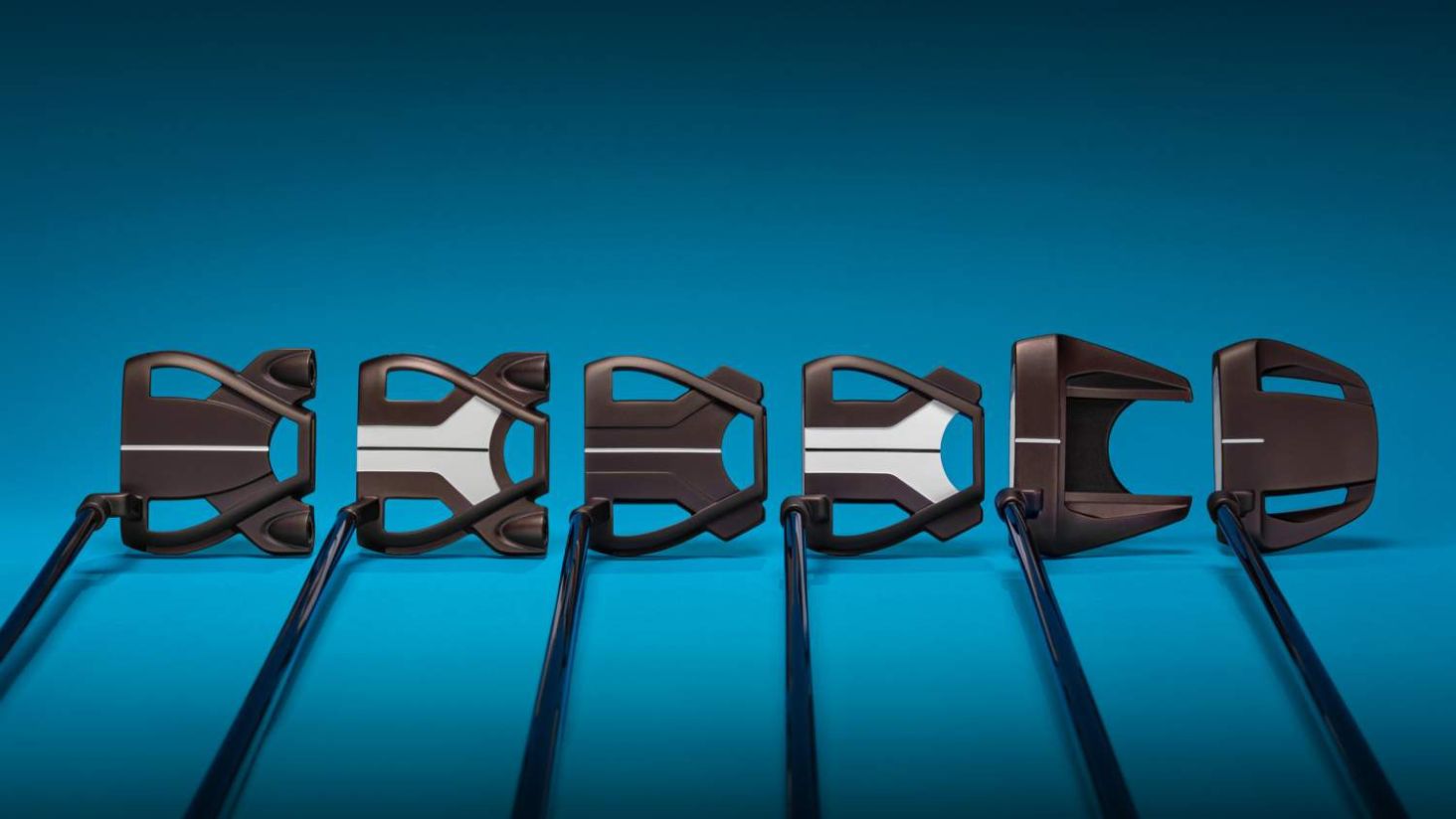
With the current Spider Tour Series —Spider Tour, Spider Tour X, Spider Tour S Counterbalance—TaylorMade consolidated the line into a clearly structured product family tailored to the needs of different stroke types. The introduction of the Spider ZT marks the latest development step to date: Zero Torque, a new design principle that consistently builds on the MOI concept and responds to the growing demand for maximum stability and counterbalance options.
More than 1.5 million Spider putters have been sold since 2008. No other model has had such a profound impact on the evolution of the modern Mallet putter—and the line continues to evolve to this day.
How does it work? Learn more about Zero Torque technology here.
An Overview of the Model Families
Spider Tour – The proven Tour classic
The Spider Tour is the foundation of the current Spider line: sleeker and more compact than earlier Spider generations, yet fully equipped with the latest technology. It combines the frame Mallet design with the Pure Roll Insert and True Path Alignment—and has been the model of choice for many Tour pros for years.
Technical Specifications:
- Stainless steel frame, gunmetal PVD finish (or black PVD with copper accents)
- HYBRAR Echo damping system for a soft, controlled feel
- KBS CT Putter Black PVD Stepless (120 g) / SuperStroke Pistol GT 1.0
- Loft 3°, Lie 70°, Lengths 33–35 inches (depending on model)
- Price: approx. 360 €
Hosel variants and their impact on the stroke:
| Variant | Hosel | Toe Hang | CG Position | Suitable for |
|---|---|---|---|---|
| Spider Tour DB | Double Bend | Face-Balanced | 35 mm | Straight Stroke |
| Spider Tour Slant | Small Slant | 29° | 35 mm | Light Arc |
| Spider Tour Black | Small Slant / DB | 29° / Face-Balanced | 35 mm | Straight to slight arc |
| Spider Tour S CB DB | Double Bend | 29° | – | Straight stroke, CB setup |
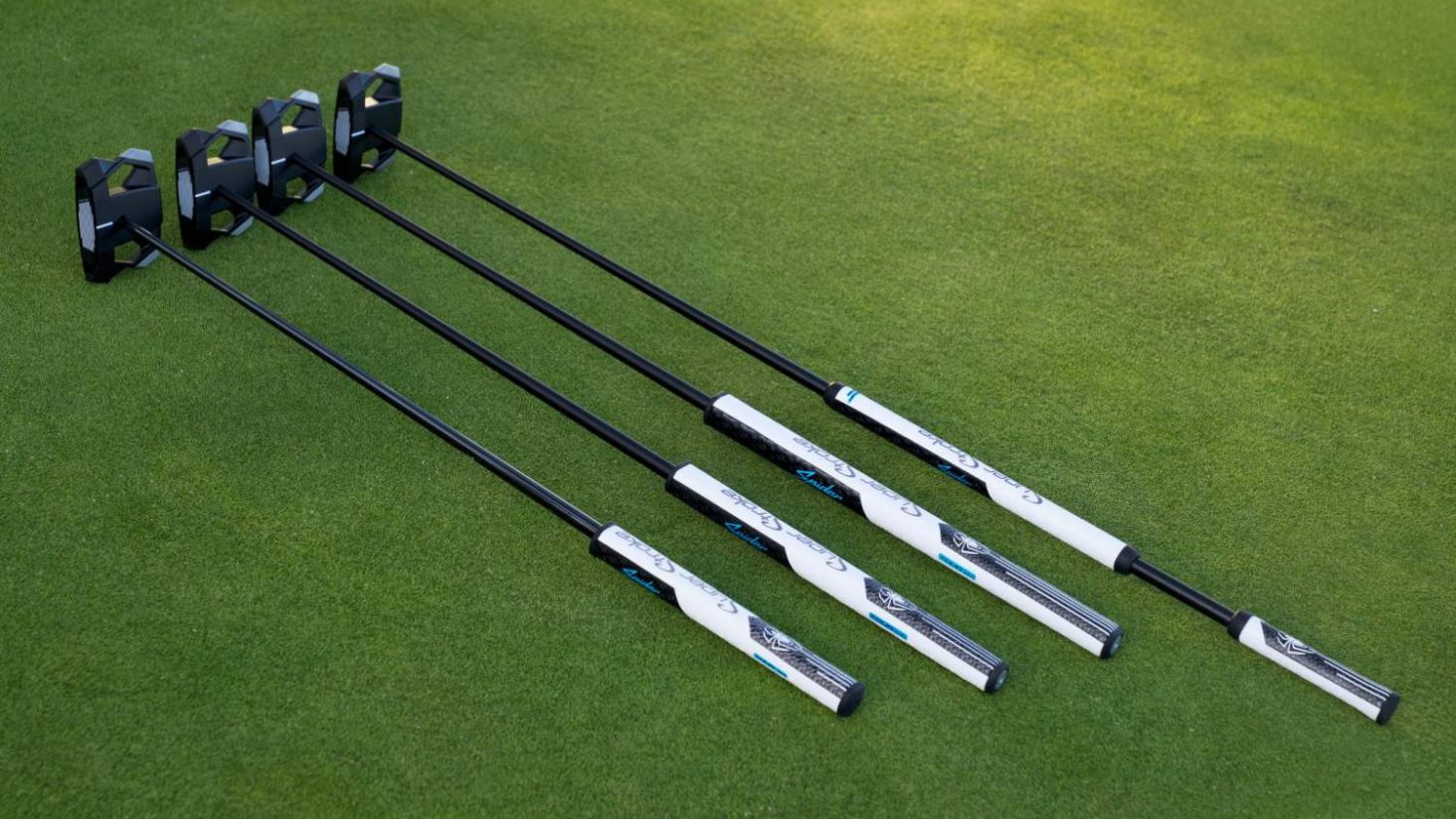
The CB (Counterbalance) version deserves special mention: It comes standard at 38 inches in length with a long SuperStroke 3.0 grip. The increased weight in the grip area shifts the center of gravity toward the wrists and reduces their influence on the stroke—an approach that’s particularly appealing to players who tend to have shaky wrists under pressure.
Spider Tour X – More Weight, Higher MOI
The Spider Tour X is based on the same basic concept as the Spider Tour, but features a physically larger, heavier head. The additional mass—especially in the corners of the frame—further increases the MOI, making the TaylorMade Spider Tour X one of the most stable standard Mallet putters on the market.
Rory McIlroy played a Spider Tour X for years, making the model the flagship of the entire line. Jon Rahm and Dustin Johnson have also used versions of the Tour X.
Technical Specifications:
- CG position: 33 mm (more compact than the Spider Tour at 35 mm)
- True Path Alignment, White TPU Pure Roll Insert
- Gunmetal PVD finish (standard) or Black PVD (Black variant)
- Loft 3°, Lie 70°, Lengths 34–35 inches
- Price: approx. 360 €
Hosel variants:
| Variant | Hosel | Toe Hang | Special Feature |
|---|---|---|---|
| Spider Tour X DB | Double Bend | Face-Balanced | Classic Tour Configuration |
| Spider Tour X L-Neck | L-Neck | 21° | Played by Scottie Scheffler |
| Spider Tour X Slant | Small Slant | ~29° | For a slight arc |
| Spider Tour X Black Slant | Small Slant | ~29° | Black PVD with copper accents |
| Spider Tour X DB Ice Mint | Double Bend | Face-Balanced | Special Edition, Mint Accent |
The L-Neck hosel is particularly noteworthy here: With a 21-degree toe hang, it falls between a fully face-balanced Putter and a classic small slant—ideal for players with a slightly arched stroke who still want more stability than a Blade Putter provides. Scottie Scheffler used this configuration and won three out of four tournaments—impressive proof of the practicality of this hosel geometry.
Where are TaylorMade golf clubs manufactured? Find out here.
Spider ZT – Zero Torque: The Technical Evolution
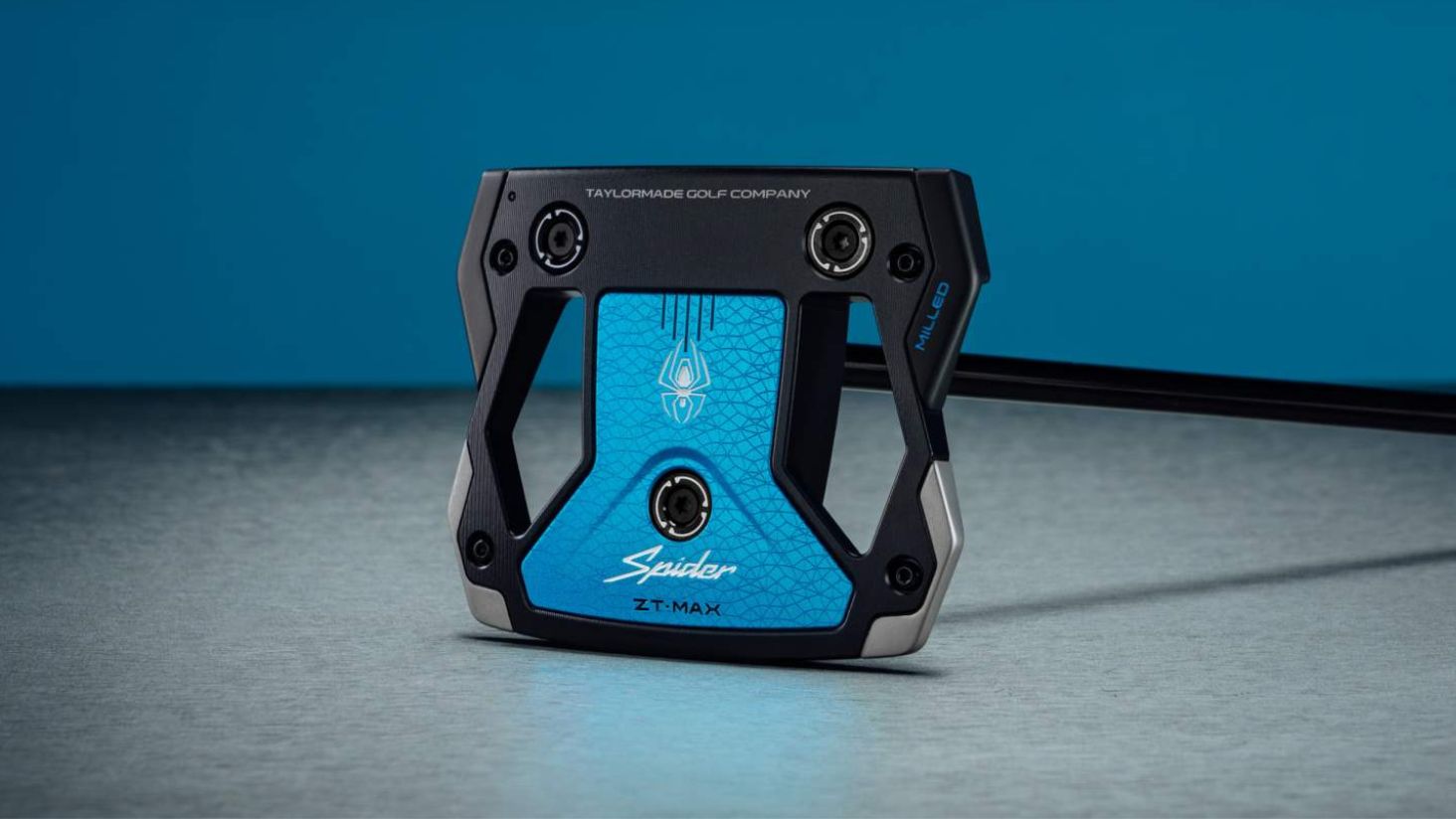
The Spider ZT series marks a qualitative advancement within the Spider family. The abbreviation “ZT” stands for Zero Torque —a design principle aimed at minimizing the torque of the clubface during the stroke.
Specifically, this means that through a specific weight distribution and hosel geometry, the putter head is balanced in such a way that it remains naturally stable during the stroke—without golfers having to actively counteract it. This is particularly relevant for players who want to strike the ball very consistently across the target line.
Technical Basis:
- Milled True Path Alignment (milled into the steel, not a glued-on element)
- Pure Roll Insert made of Surlyn + aluminum
- Loft 2.5°, Lie 70° (slightly flatter than the Spider Tour → for more precise roll control)
- Stainless steel + aluminum construction
- Price: approx. 400–620 € (depending on the model)
Variants:
| Variant | Length | Special Feature |
|---|---|---|
| Spider ZT (Standard) | 34–35 inches | Entry-level model in the ZT line |
| Spider ZT CB | 34–35 inches | Counterbalance configuration |
| Spider ZT Black CB | 36–38 inches | Belly/armlock length, graphite shaft 155 g |
| Spider ZT Long | 42–48 inches | Long Putter setup (broomstick/belly) |
The Spider ZT Black CB is the most technically advanced model in this line: With lengths up to 38 inches, a massive head weight of 395 g, and a KBS GPS Custom graphite shaft (155 g), it is designed for armlock putting. The counterbalance principle is taken to the extreme here—the Putter is meant to move like a pendulum guided by forearm rotation. Price: approx. 620 €.
The Spider ZT Long also offers lengths well above the standard and is aimed at players who prefer a very long Putter configuration for reasons of physical stability or personal preference.
Spider Torched Tour X – The Current Top of the Line
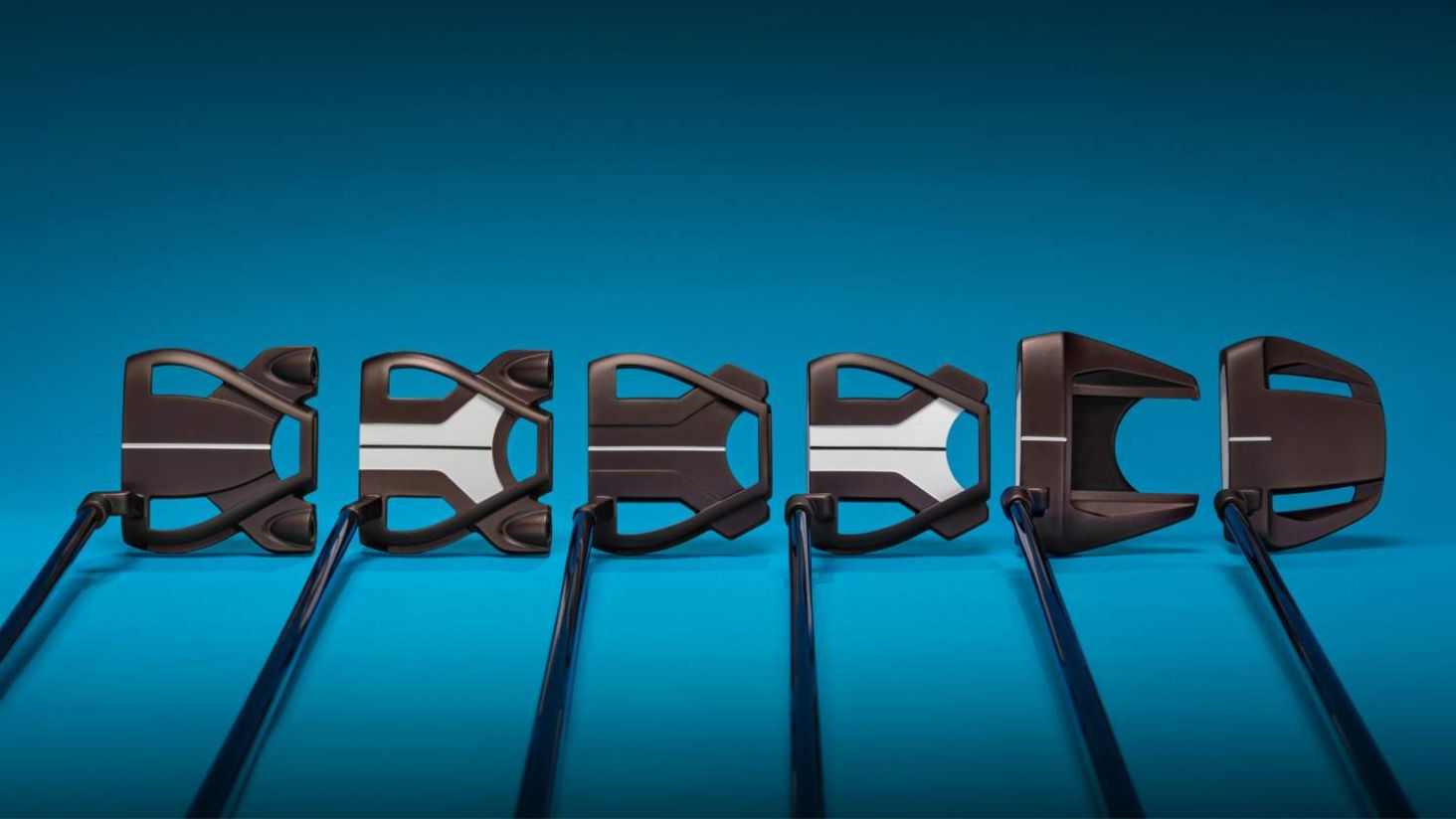
The Spider Torched Tour X is the newest member of the family and represents the current state-of-the-art in Spider technology and design. The eponymous “Torched” finish is a heat-treated PVD process that gives the clubface a distinctive, slightly iridescent color—a finish that is instantly recognizable on the Tour and is deliberately used as a mark of quality.
Technical Specifications:
- CG position depending on variant: 34–36 mm
- Milled True Path or Single Line Alignment
- Pure Roll Insert, KBS CT PVD shaft
- Loft 3°, Lie 70°
- Price: approx. €400 and up
Variants:
| Variant | Hosel | Toe Hang | CG | Alignment |
|---|---|---|---|---|
| Spider Torched Tour X TP #1 | L-Neck | 21° | 36 mm | True Path |
| Spider Torched Tour X SL #3 | Small Slant | 30° | 34 mm | Single Line |
| Spider Torched Tour X TP #3 | Small Slant | 30° | 34 mm | True Path |
The designations #1 and #3 refer to different head positions, not to a hierarchy of quality. The TP models feature the full True Path alignment, while the SL model features a reduced Single Line—for players who prefer less visual information on the clubhead.
Special Editions
Spider White (Ghost White)
The Spider White is an older model in the Spider line, distinguished by its striking, all-white finish. It was built at a time when TaylorMade sought to optimize alignment aids through maximum contrast with the green surroundings using the “Ghost White” concept. Technically, it belongs to an earlier generation, but it features the proven Pure Roll Insert and the classic Spider frame made of aluminum and steel. Anyone who finds one today gets a model with clear performance advantages at a significantly reduced price.
Kalea Gold Spider 1 – The Women’s Model
The TaylorMade Kalea Gold Spider 1 is the Spider from the Kalea line, which was developed specifically for female golfers. Although the most striking feature is the gold finish, the Kalea Spider also differs technically from the standard men’s model: a lighter overall construction, adjusted lie angles, and shorter shaft options for an ergonomically tailored configuration.
The core Spider technology—Pure Roll Insert, Mallet frame, True Path Alignment—is fully present here as well. The Kalea Gold Spider 1 is therefore not merely a cosmetic product, but a full-fledged technology putter in a women’s-specific configuration.
Hosel Types in Detail: What Do They Mean for Your Stroke?
Choosing the right hosel is at least as important as the head shape when it comes to a Putter. Here’s an overview of the most important types:
| Hosel Type | Toe Hang | Stroke Recommendation | Spider Models |
|---|---|---|---|
| Double Bend (DB) | Face-Balanced | Straight-Through Stroke | Spider Tour DB, Tour X DB, ZT CB |
| Small Slant | ~29–30° | Light Arc | Spider Tour Slant, Tour X Slant, Black Slant |
| L-Neck | ~21° | Light to moderate arc | Spider Tour X L-Neck, Torched Tour X TP #1 |
| Center Balance (CB) | Face-Balanced | Straight Stroke + Counterbalance | Spider ZT CB, Spider ZT Black CB |
What exactly does “toe hang” mean? If you balance a Putter horizontally on your finger and the clubface tilts downward—that’s toe hang. 0 degrees (face-balanced) means the face points upward. 90 degrees would be a full Blade putter with maximum arc. The Spider falls within a range of 0 to 30 degrees—it’s fundamentally designed for straight to slightly arced strokes.
The Spider on the Tour: What “Pro Use” Really Means
There are putters that claim to be played on the Tour. With the Spider, you can verify this. In the statistics on the most-used Putter models on the PGA Tour and the DP World Tour, the Spider family regularly ranks among the top—not because of a marketing budget, but because Tour caddies and players only honor their bag deals if a product truly impresses them.
Rory McIlroy is the most recognizable face of the Spider Tour X. He used the model for several years and won with it. According to him, the face balance was the deciding factor in his choice: His stroke is very straight, making him the ideal candidate for a Double Bend Putter.
Scottie Scheffler, currently the world’s No. 1, played the Spider Tour X L-Neck and won with it during one of the most dominant stretches the Tour has ever seen. The L-Neck model with a 21-degree toe hang is an unusually specific configuration—a sign that Scheffler and his fitting team worked with great precision.
Jon Rahm and Dustin Johnson are also among the group of Tour players who have carried Spider variants in their bags and achieved major-level success with them.
What does this mean for amateur golfers? First and foremost: reputation built on results. A Putter trusted under the pressure of majors, on the fastest greens, and with millions of dollars in prize money at stake is engineered to the highest technical standards. That doesn’t automatically mean a Tour Putter is the right choice for every amateur golfer—but it proves that the technology works.
Buying Guide: Which TaylorMade Spider Putter is right for you?
Here’s a quick decision guide:
You have a very straight stroke and are looking for maximum stability:
→ Spider Tour X DB or Spider ZT (Standard)
If you have a slightly arched stroke and prefer a compact alignment:
→ Spider Torched Tour X SL #3 (Single Line) or Spider Tour Slant
You tend to have shaky wrists under pressure:
→ Spider Tour S CB DB (Counterbalance) or Spider ZT CB
You want the model with the most advanced technology and a premium finish:
→ Spider Torched Tour X TP #1 or TP #3
You’re looking for a setup suitable for armlock or belly play:
→ Spider ZT Black CB (36–38 inches) or Spider ZT Long
If you’re a female golfer looking for a full-featured technology putter:
→ Kalea Gold Spider 1
Your budget is limited, but you’d still like to use Spider technology:
→ Spider White (older generation, reduced price, proven technology)
FAQ: The Most Common Questions About the TaylorMade Spider
What’s the difference between the Spider Tour and the Spider Tour X?
The Spider Tour X has a larger, heavier head with a higher MOI. The CG position is 33 mm on the Tour X and 35 mm on the Spider Tour—technically, this means the Tour X has a slightly more compact head geometry while also having more weight in the corners. In practice, the Tour X feels noticeably more stable, looks more imposing, and is designed for players who prioritize maximum forgiveness over maximum feel.
Is the TaylorMade Spider face-balanced?
That depends on the hosel variant selected. Double Bend and L-Neck hosels are face-balanced or nearly face-balanced. Small-Slant hosels provide 29–30 degrees of toe hang. The CB versions are also face-balanced, but with a counterbalance setup.
What is the Pure Roll Insert?
A laminated insert made of Surlyn and aluminum with 45-degree grooves on the face. The grooves promote early forward rotation of the ball and reduce skidding at first contact. The result is more consistent roll—especially on fast greens.
What is the difference between the Spider ZT and the Spider Tour?
The Spider ZT stands for “Zero Torque” and features more sophisticated construction: The alignment is milled directly into the steel (no sticker), the loft is 2.5 degrees instead of 3 degrees, and the counterbalance models are designed for specific stroke types. The Spider ZT is the next evolution for golfers who are already familiar with the Spider Tour and want to take another step toward technical precision.
Who is a Mallet Putter like the TaylorMade Spider actually suitable for?
Generally, it’s for players with a straight to slightly arcing stroke who benefit from a large head with high MOI. The Spider Mallet Putter is particularly well-suited when stability and alignment accuracy are priorities. Players with a strongly arcing stroke often do better with a Blade putter. If you’re unsure, you should get a professional putter fitting—your technique will only be optimal if it matches your individual stroke.
Conclusion
The TaylorMade Spider is not a product line defined by marketing. It is the result of consistent technological development based on Tour feedback, which must hold its own year after year in one of the world’s most competitive sports.
Anyone who compares TaylorMade putters and buys a Spider gets a Mallet putter with clear technical strengths: high MOI, consistent alignment, the proven Pure Roll Insert—and a history forged on the greens of the majors.
Choosing the right TaylorMade Spider golf putter depends on your individual stroke type, your preferred length and weight configurations, and your budget. If you want to be sure, we recommend a professional Putter fitting—the technical differences between the models are real, but they only work optimally when the Putter is a good fit for the player.

Brandname
Title will go here and can run on two lines
Brandname
Title will go here and can run on two lines
Brandname
Title will go here and can run on two lines
Brandname
Title will go here and can run on two lines
Brandname
Title will go here and can run on two lines
Brandname
Title will go here and can run on two lines
Brandname
Title will go here and can run on two lines
Brandname
Title will go here and can run on two lines
Release date
05 Jul 2026
photos
TaylorMade's Spider putters are now among the most famous golf clubs of all. (Photo: TaylorMade)