2027 Ryder Cup: How the U.S. Team Qualifies
2027 Ryder Cup: New points system to determine the U.S. team—six spots based on points, six via captain's pick.
Qualifying for the U.S. Ryder Cup team will work fundamentally differently in 2027. The PGA of America is adopting a points system that takes into account only results from the calendar year of the Ryder Cup. Previous achievements, which would still have counted under the previous model, will no longer play a role.
The first points will be awarded at The American Express tournament in January 2027 on the PGA Tour. Qualifying concludes with the BMW Championship in August. A total of 31 tournaments will be taken into account. Six players will then be selected based on the points standings; Captain Jim Furyk will award six additional spots via Captain’s Pick.
No points from 2026
The most significant change concerns the scoring period. Only tournaments taking place in 2027 will count toward the U.S. selection for the 2027 Ryder Cup. Points from the majors or from the 2026 Players Championship will not carry over.
This is the PGA of America’s response to a weakness in the previous system: Players could gain an advantage with strong performances the previous year, even if their form declined during the Ryder Cup year. The new process, on the other hand, is intended to better reflect who is actually playing at a high level between January and August 2027.
Among those affected are Cameron Young and Wyndham Clark. Young won The Players Championship in 2026, and Clark won the U.S. Open. Under the previous rules, these victories could have played a role in Ryder Cup qualification. Under the new system, both—like all other U.S. players—will start with zero points from the 2026 season.
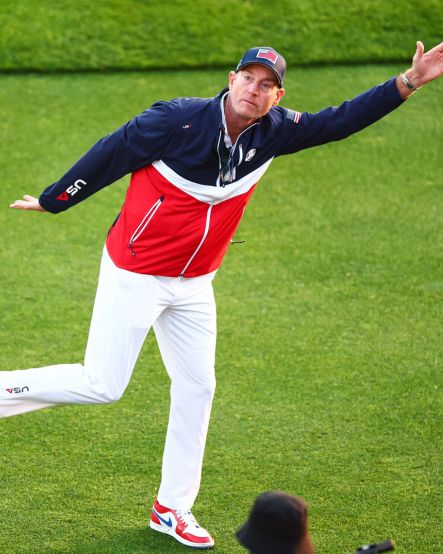
Thus, Jim Furyk was named captain of the U.S. team for the 2027 Ryder Cup.
Prize money is no longer the basis
There is also a fundamental change in how points are calculated. Until now, U.S. qualification was based on official prize money. This became increasingly problematic because the financial conditions on the PGA Tour have diverged significantly.
The eight signature events feature particularly high prize money and strong fields. Their total prize money can exceed $20 million, while regular tournaments offer significantly lower prize pools. A ranking system based directly on money earned therefore automatically favors the most lucrative competitions.
Jim Furyk had already addressed the issue back in May. “We’re aware that we have a problem. Right now, everything is based on money. The prize money structures are completely out of balance,” the U.S. captain said, according to Golfweek, at the PGA Championship. Instead of prize money, a fixed points system will be used in the future. It ranks the various tournament categories according to their importance and creates a uniform basis for the rankings.
Majors are ranked highest
The biggest point payouts come from the four major championships. A victory at the Masters, the PGA Championship, the U.S. Open, or the Open Championship is worth 3,000 points. This means a major victory is worth more than a win at any other tournament.
The Players Championship awards 2,850 points to the winner. The winners of the Signature Events and the two playoff tournaments—the FedEx St. Jude Championship and the BMW Championship—each receive 2,250 points. At a regular full-field event, the tournament winner receives 1,500 points.
| Tournament Category | Points for the Winner |
|---|---|
| Major Championships | 3,000 |
| The Players Championship | 2,850 |
| Signature Events | 2,250 |
| Playoff Tournaments | 2,250 |
| Regular PGA Tour tournaments | 1,500 |
The winner’s point total is the maximum possible. Other players also receive points as long as they make the cut and finish the tournament. The exact number depends on their finishing position and decreases according to the established distribution.
Signature events that count toward the standings include, among others, the AT&T Pebble Beach Pro-Am, The Genesis Invitational, the Arnold Palmer Invitational, the Memorial Tournament, and the Travelers Championship. However, opposite-field events that take place concurrently with higher-ranked tournaments are not included. A special rule applies to the Zurich Classic of New Orleans. In this team tournament, only teams whose two players are both eligible to play for the U.S. Ryder Cup team can earn points.
Six spots via the rankings, six selected by the captain
At the conclusion of the BMW Championship, the six highest-ranked eligible U.S. players on the points list receive an automatic spot on the team. After that, Jim Furyk retains considerable discretion: The captain may select six additional players. These Captain’s Picks are to be announced during the week of August 30, 2027, following the Tour Championship.
The ratio of six automatic qualifications to six picks is not new. It has been in effect for the U.S. team since the 2021 Ryder Cup. What is new, however, is how the six automatic spots are determined.
However, a high ranking on the points list does not automatically guarantee a spot. Players must also meet all applicable eligibility requirements, such as playing a minimum number of tournaments.
Current Form Over Previous Season’s Performance
In terms of performance, the emphasis is thus shifting significantly toward the present. A player who wins a major in the spring of 2027 or consistently finishes near the top in several high-profile tournaments can build a decisive lead. At the same time, a major success from the previous year is no longer enough to improve one’s starting position.
The new system thus primarily rewards two qualities: performance at the highest-ranked tournaments and consistency throughout the entire qualification period. Since point accumulation begins as early as January and ends after the BMW Championship, a strong start to the season will also be important.
For players associated with LIV Golf, advancing via the points list is likely to become more difficult. LIV tournaments are not among the 31 events at which Ryder Cup points are awarded. However, what matters is not simply which Tour a player belongs to, but whether a player is eligible to compete in the qualifying tournaments and meets the official eligibility requirements. Therefore, an automatic ban cannot be inferred from the new points system.
Differences from the European Model
The U.S. system resembles the European selection process in some fundamental ways. Europe also relies on a points list and six captain’s picks. However, the time frame is not identical: The European qualification process already includes tournaments from late 2026, while the U.S. ranking system does not begin until the 2027 season.
The American selection process is thus more focused. For the twelve spots, either performance in the 31 qualifying tournaments of the Ryder Cup year or the captain’s assessment counts.
Furyk Wants the Strongest Players in September
Furyk explains that the reform is aimed at finding the strongest U.S. team from a competitive standpoint. “I’ve worked closely with our team on this process and am excited to implement a new qualification system for the 2027 U.S. Ryder Cup team. We have an exceptional mix of experienced players and up-and-coming talent. This system will help us identify the strongest players in September 2027,” Furyk said in a statement from the PGA of America.
For the captain, the task is particularly challenging because the U.S. is looking to end a long losing streak on foreign soil. The 2027 Ryder Cup will take place September 17–19 at Adare Manor in Ireland. The U.S. team has not won on European soil since 1993. Europe has also won the past two editions.
The new qualification system therefore establishes a clear competitive narrative early on: Starting in January 2027, every relevant performance will count until the top six spots are filled following the BMW Championship. After that, Furyk’s part of the selection process begins. Whether the new system will actually produce the strongest team, however, will only become clear on the course.
Brandname
Title will go here and can run on two lines
Brandname
Title will go here and can run on two lines

Brandname
Title will go here and can run on two lines
Brandname
Title will go here and can run on two lines
Brandname
Title will go here and can run on two lines
Brandname
Title will go here and can run on two lines
Brandname
Title will go here and can run on two lines
Brandname
Title will go here and can run on two lines
Brandname
Title will go here and can run on two lines
Brandname
Title will go here and can run on two lines
Release date
10 Sep 2026
photos
Jim Furyk, pictured here as assistant captain for the 2025 Ryder Cup, has redefined the qualification criteria for the 2027 transatlantic showdown. (Photo: Imago / Shutterstock)