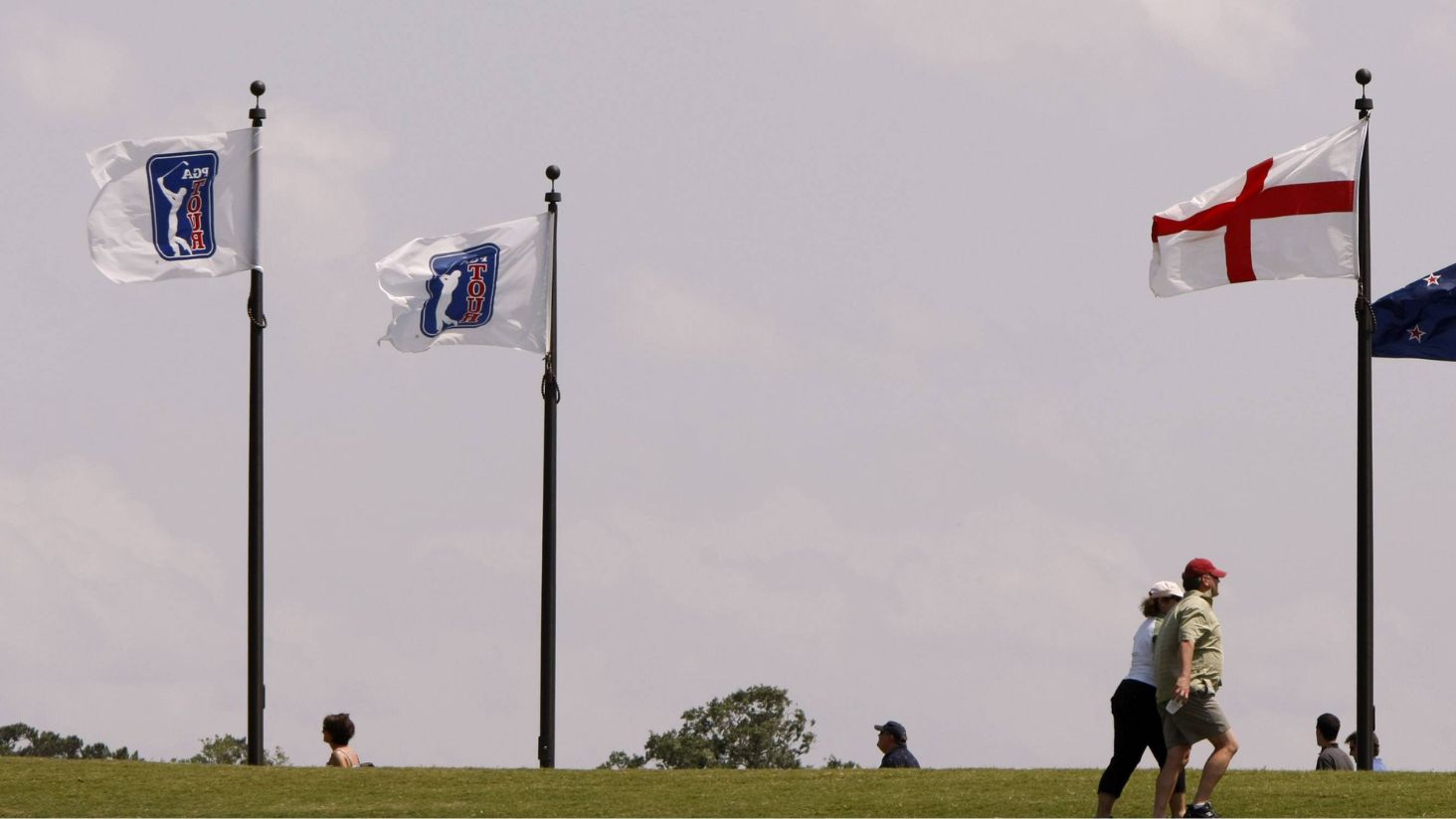
PGA Tour 2028: The Biggest Reform in the History of Professional Golf
Starting in 2028, the PGA Tour will be divided into the Championship Series and the Challenger Series. Here’s an overview of what this means for players, fans, and the sport—all the facts at a glance.
Golf is on the verge of its most far-reaching structural reform in decades: Starting with the 2028 season, the PGA Tour will split into two separate series—featuring promotion and relegation, postseason match play, and the end of sponsor exemptions. What was officially announced on Tuesday in Cromwell, Connecticut, is more than just a course correction. It’s a fresh start.
A Historic Tuesday for the PGA Tour
Cromwell, Connecticut, June 24, 2026. In the clubhouse at TPC River Highlands, host venue of the ongoing Travelers Championship, Brian Rolapp steps up to the microphones. Beside him: Tiger Woods, making his first public appearance in the golfing world after months of absence. What the two of them are presenting on this Tuesday morning is unprecedented in the history of the PGA Tour.
The day before, on Monday, the PGA Tour’s board had voted nearly unanimously in favor of a new competition model set to take effect starting in the 2028 season. The reform is the result of nine months of intensive work, hundreds of model iterations, and countless discussions between players, sponsors, media partners, and Tour officials. In terms of its structural depth, it is the most significant change in professional golf since the PGA Tour was founded in August 1968.
“One Tour. Two compelling series of tournaments, played on the most prestigious courses, for the highest stakes, with a true postseason finale that crowns the world’s best golfer,” Rolapp said at the press conference.
Key Points at a Glance
- Two series starting in 2028: Championship Series (Elite) and Challenger Series (promotion track)
- Championship: 23–24 events, ~120 players, at least $20 million in prize money, Feb–Aug
- Challenger: at least 20 events, ~144 players, at least $4 million in prize money
- Promotion & Relegation: Top 90 in the Championship retain their status; top 20 from the Challenger Series are promoted
- Postseason: Tour Championship to be held in a match-play format going forward, with rotating venues
- No moresponsor exemptions in the Championship division
- Effective: 2028 season; eligibility criteria will be determined prior to the 2027 season
A letter to fans on the future of the @PGATOUR. pic.twitter.com/WAFJwFEV7y
— Brian Rolapp (@brianrolapp) June 23, 2026
The Background: Why Now, and Why So Radical?
These reforms didn’t come out of nowhere. The PGA Tour has had a turbulent few years. With the emergence of the LIV Golf League in 2022, the Tour not only lost some of its most prominent names—it also had to face uncomfortable questions: Why do the world’s best golfers so rarely play against each other? Why is the field at non-Signature events often alarmingly thin? Why does hardly anyone understand how the points system actually works?
For years, the Tour’s response to this criticism was a laborious series of piecemeal measures: Elevated Events here, Signature Events there, field size restrictions, and changes to the FedEx Cup format. Each solution created new problems. Players who had just won their Korn Ferry titles and were hoping to break into the main Tour suddenly found themselves shut out of the most lucrative fields.
When Brian Rolapp took the helm in August 2025—coming from the NFL, where he most recently served as Chief Media Officer—he already had a clear vision of what he wanted: clarity, scarcity, parity. Three words he has repeated like a mantra in the months since. One of his first moves as CEO was to establish the Future Competition Committee (FCC), a nine-member panel with the explicit mandate to completely rethink the Tour’s competitive structure from the ground up.
The committee was led by Tiger Woods. In addition to five other player representatives—Patrick Cantlay, Maverick McNealy, Keith Mitchell, Adam Scott, and Camilo Villegas—Rolapp also brought three strategic advisors from the business world on board: Joe Gorder, John Henry, and Theo Epstein.
The latter is perhaps the most surprising name in the group. Epstein is one of the most famous baseball managers of modern times—under his leadership, the Chicago Cubs won the World Series in 2016, for the first time in 108 years. What’s more, Epstein is considered one of the architects of the structural reforms that have brought about a renaissance in baseball in recent years. The pitch clock, new extra-innings rules, and modified defensive formations—all of these have helped make the game faster, more dynamic, and more accessible to a new audience.
In a passionate letter that Epstein sent to the Tour boards over the weekend ahead of the decisive vote, he invoked this comparison and argued that the proposed changes to the PGA Tour offer “far greater potential and more upward momentum” than even MLB’s spectacular successes.
Two PGA Tour Series—What’s Behind Them?
The Championship Series: The new elite tier
At the heart of the reform is the division into two parallel series. The PGA Tour Championship Series is the new name for the pinnacle of professional golf. It comprises 23 to 24 tournaments per season, including the four major championships, The Players Championship, the respective team competitions (Presidents Cup or Ryder Cup), and a newly designed postseason. The regular season consists of 15 tournaments—ten of which have already been identified for 2028; there is likely to be significant overlap with the current Signature Events.
The season kicks off in February with a major opening tournament and ends in August—significantly earlier than before, which deliberately leaves room for international events in the fall. The fields will comprise around 120 players, with a 36-hole cut for the top 65 and ties. The prize money: at least $20 million per event. By comparison, the prize money for the 2026 U.S. Open was $22.5 million.
Two decisions are particularly symbolic: There will nolonger be sponsor exemptions, and there will be no alternate list either. Anyone who hasn’t qualified through on-course performance simply won’t play. A sponsor will not be able to prop up a star friend who, in reality, has long since fallen behind. “When fans tune in to the PGA Tour Championship Series, they know they’ll see the world’s best players going head-to-head,” Rolapp explained at the press conference.
The Tour has also explicitly announced that it will expand into new markets when allocating the remaining five tournament slots. The cities mentioned were Boston, Denver, New York, Philadelphia, San Francisco, Seattle, and Washington, D.C.—metropolises that have appeared rarely or not at all on the tournament calendar to date.
The Challenger Series: More Than Just a Second Division?
Running parallel to this is the PGA Tour Challenger Series —and this is one of the most politically contentious aspects of the entire reform. The Challenger Series is designed as the primary pathway to promotion to the Championship Series. It comprises at least 20 tournaments per season, with fields of around 144 players, a 36-hole cut, and prize money of at least four million dollars per event.
About seven of these Challenger events are held during the Championship Series’ off-weeks—that is, during the weeks when the elite take a break. These events are to be given greater consistency, more attention, and better conditions.
Even before the official announcement, Rory McIlroy —the reigning Masters champion—had described the planned second series in less-than-flattering terms: “Track Two is a upgraded Korn Ferry event. That’s what Track Two will be,” he had said during the week of the U.S. Open.
Rolapp didn’t take this criticism lying down. He pointed out that the Tour would continue to offer around 47 events for about 230 players—the same basic structure as before, just better organized. “If you look at the Challenger Series events, you’ll recognize venues you’re familiar with. There will be healthy prize money. The players will come from the existing pool of 200 or more professionals. This is something completely different from the Korn Ferry Tour as it stands today.” Notably, McIlroy himself backtracked after the official announcement, calling it “a positive step for professional golf.”
Promotion & Relegation
What sets the new structure apart from everything that came before is the introduction of a true promotion and relegation system—the most rigorous golf has ever seen.
The basic rule is simple: The top 90 players on the Championship points list retain their status for the following season. The top 20 from the Challenger Series are promoted. The starting field for the following year’s Championship Series is composed of these 110 players plus additional categories yet to be defined—tournament winners, medical exemptions, career milestones.
Anyone who finishes 91st or lower in the Championship Series is relegated. No ifs, ands, or buts. No safety net in the form of preferential starting fields or good connections with the tournament director. However, there is one last loophole: the so-called “Last Chance” Series. Four to six events in the fall offer players facing relegation one very last chance to retain their Championship status. Anyone who fails there as well will compete in the Challenger Series the following season.
For anyone wondering who exactly would be affected: If the current season had already taken place under the new rules, players like Taylor Pendrith, Marco Penge, Denny McCarthy, Rasmus Højgaard, or Mackenzie Hughes would be outside the top 90—and thus in the relegation zone.
A particularly attractive feature: Anyone who wins twice in a season on the Challenger Series earns immediate promotion to the Championship Series—even while the current season is still underway. This is a strong incentive model for the Challenger Series, making it more than just a holding pen.
The Postseason Revolution
Perhaps the topic that excites golf enthusiasts the most: The Tour Championship—the PGA Tour’s season finale—will be played in a match-play format starting in 2028. For years, this idea had been discussed and ultimately always rejected, most recently with the argument that it was inconsistent to end a stroke-play season with match play. Rolapp dismissed this argument. For him, what counts is the TV moment, the suspense, the head-to-head duel.
Equally revolutionary: The Tour Championship is leaving its long-time home. Since 2004, the East Lake Golf Club in Atlanta has been the permanent venue for the season finale. That’s coming to an end—at least as a permanent home. Instead, the tournament will rotate among the most prestigious golf courses in the U.S. in the future. On the wish list are legendary courses such as Pine Valley Golf Club in New Jersey, Cypress Point Club in California, and Seminole Golf Club in Florida—courses that have never before hosted a regular PGA Tour event.
The format of the new playoffs has not yet been fully determined, but it is expected to include a group stage followed by a knockout round and will span two weeks. The basic idea: a competition that feels like a championship—with clear losers and a definitive champion. And: For the first time, in addition to the postseason champion, there will also be a regular-season champion, recognized as a separate award. The player who has performed most consistently over the entire season will hold this title.
The Minds Behind the Reform
Brian Rolapp: The Man with the Master Plan
Brian Rolapp is not a golf insider. He comes from the world of football—as Chief Media Officer of the NFL, he played a key role in marketing the world’s most valuable sports rights package. It was precisely this perspective that he brought with him when he became CEO of the PGA Tour in August 2025: How do you make a sports league so attractive to broadcasters and media companies that they’re willing to pay record sums for broadcast rights? The answer he developed with the FCC is: clarity, scarcity, and consistency.
In addition to his role as CEO, Rolapp will now also hold the title of PGA Tour Commissioner—the fifth commissioner in the Tour’s history and the successor to Jay Monahan.
Tiger Woods: A Resounding Return
Tiger Woods was the chair of the Future Competition Committee—and thus the sporting heart and soul of the reform. The fact that he remained involved in the committee’s work and traveled to Cromwell for the vote despite a difficult personal period (Woods was arrested in Florida in March 2026 on suspicion of driving under the influence and subsequently sought treatment abroad) underscores how important this project is to him. His first public appearance since the incident came across as focused and determined.
“This work was never focused on a single person or a single player. It was about bringing different perspectives together, having honest and difficult conversations, and thinking boldly—for the sake of the sport we all love,” Woods said at the press conference.
Theo Epstein: The maverick
At first glance, Theo Epstein might seem out of place on a golf committee. The man who, as general manager of the Boston Red Sox (2004) and the Chicago Cubs (2016), orchestrated two of the most iconic World Series championships in baseball history is considered one of the sharpest minds in American professional sports. At the FCC, he was the voice that repeatedly reminded everyone of what structural reforms have achieved in other sports. His plea for “consequence and jeopardy”—that is, genuine sporting consequences and suspense through risk—runs like a common thread through the new competition model.
Voices & Reactions to the PGA Tour Reform
Monday’s vote was nearly unanimous. The sole exception: Patrick Cantlay, an eight-time Tour winner and himself a member of the FCC, abstained. He did not issue a public statement on the matter—a small but significant signal that not all players are fully convinced.
Rory McIlroy, whose critical remarks had caused a stir just the week before, released a statement following the announcement that marked a remarkable shift in tone: “Today’s announcement is a positive step for professional golf. It’s encouraging to see the PGA Tour reaffirm the importance of meritocracy and create a structure that will serve players and fans well into the future. [...] In recent years, golf has gone through a period of uncertainty and division that was in the interest of neither the players nor the fans. Today, we’re putting the fans first, and I’m excited about the future of our sport.”
Maverick McNealy, player representative on the FCC, summed it up simply at the press conference: “In some ways, it’s a big change, but in other ways, it will be the PGA Tour you know and love. You’ll just know where to find it. You’ll know when it starts, when it ends, and who usually plays each week.”
What Remains to Be Seen
As far-reaching as the reform is—significant parts of it are not yet finalized. Anyone hoping to know right now whether the Memorial Tournament will be a Championship or Challenger event in 2028 will have to wait: The complete schedule is not expected to be announced until the first quarter of 2027. Until then, negotiations with existing tournaments must be conducted, new markets tapped, and sponsors convinced. These are tough talks that are only just beginning.
Also unresolved:
- LIV players: Rolapp elegantly deflected all questions on the matter. The players are under contract, and he said he is not currently considering reintegrating them. Whether Bryson DeChambeau, Jon Rahm, or others will ever return to the new system remains to be seen.
- FedEx as a postseason sponsor: The current contract expires in 2027—which is exactly when the new structure is set to launch. What happens after that is a matter for negotiation.
- DP World Tour, Korn Ferry & Co.: It has not yet been determined how many starting spots the European and development tours will receive under the new structure. These details are also expected to be finalized before the 2027 season.
- Injury Policies and Career Exemptions: How the Tour will handle injured players who cannot defend their Championship spots through on-course performance has not yet been decided.
Context: Opportunity, Risk—and the Big Picture
What was decided on Tuesday in Cromwell is no cosmetic procedure. It is open-heart surgery on a living patient—and as with any such procedure, healing and risk go hand in hand.
The opportunities are clear: Finally, the best players will compete against each other on a regular basis. Finally, every match will have real stakes. At long last, fans around the world can clearly see who the best player of the season is. And at long last, with match play in the postseason, a format is being introduced that can captivate even those unfamiliar with the sport—because, unlike stroke play, it’s based on direct head-to-head matchups. The reform gives professional golf back what the sport has always had in its greatest moments: clarity and drama.
The risks are just as real. The Challenger Series has yet to earn its reputation. McIlroy’s warning about a “gussied-up Korn Ferry event” will fade away if big names play there—and it could become very loud if the field is too thin and too unknown week after week. Whether sponsors are willing to pay for Challenger events while the elite play across the way is an open question with explosive business implications.
Added to this is the structural risk inherent in any ambitious reform: the gap between vision and implementation. Over the past five years, the PGA Tour has regularly announced plans that were either delayed or watered down. Plans for 2025 were pushed back to 2026, then to 2027—and now there are solid plans on the table for 2028. Rolapp himself acknowledged that “there is still a lot of work ahead of us.”
Nevertheless, what was decided in Cromwell is the boldest step the PGA Tour has taken since its founding. Tiger Woods helped shape this process and lent it legitimacy with his name; Theo Epstein provided intellectual inspiration; and Brian Rolapp drove it forward with the pragmatism of a media executive who values ratings more than tradition for tradition’s sake.
Professional golf has long been a labyrinth—too many events, too little excitement, too little consistency. Starting in 2028, it’s supposed to be a competition—one that people can understand, follow, and feel. Whether that succeeds won’t be decided on Monday evening in a conference room in Connecticut. It will be decided on the course.

Brandname
Title will go here and can run on two lines
Brandname
Title will go here and can run on two lines

Brandname
Title will go here and can run on two lines
Brandname
Title will go here and can run on two lines
Brandname
Title will go here and can run on two lines
Brandname
Title will go here and can run on two lines
Brandname
Title will go here and can run on two lines
Brandname
Title will go here and can run on two lines
Brandname
Title will go here and can run on two lines
Brandname
Title will go here and can run on two lines
Release date
24 Jun 2026
photos
Brian Rolapp, CEO of the PGA Tour, announced sweeping changes to the PGA Tour's structure on Tuesday. (Photo: Zuma Press)