
Broomstick and Belly Putters Explained – Types, Rules, and Who Really Needs Them
Banned or Not? Broomstick and Belly Putters Explained—Including the Rules, the Langer Case, and the Question of When a Long Putter Really Helps
Anyone seeing it for the first time will instinctively think of a broom. The broomstick Putter—measuring 48 to 52 inches—is almost twice as long as a standard Putter. And yet, golfers have won majors with it, salvaged their Tour careers, and made putts on the world’s toughest greens for decades.
The long Putter isn’t a curiosity. It’s a solution to a very real problem—and at the same time one of the most hotly debated pieces of equipment in modern golf.
The fundamental problem: When the hands betray the Putter
A standard men’s Putter measures 33 to 34 inches. It’s guided with both hands, and the motion comes from the shoulders and arms—a controlled pendulum that’s precise and repeatable. At least, that’s the theory.
In practice, many golfers struggle with what’s known as the yips: an involuntary twitch or cramping of the wrists at the crucial moment of the Putt. It’s not just amateurs who are affected. Bernhard Langer, a two-time Masters champion, temporarily lost control of his putting—before switching to a long Putter and becoming a dominant force on the PGA Tour Champions, the American over-50 Tour.
The principle behind long Putters is physically simple: the more the club is guided along a fixed point or an extended lever, the less influence the fine motor skills of the wrists and the nervousness of the moment have on the stroke. The Putter becomes an extension of the body—it oscillates rather than swings.

An Overview of the Three Types of Long Putters
Not every long Putter works the same way. There are three basic designs—with different lengths, stances, and, crucially, different rule statuses.
Armlock Putter – 40 to 42 inches
The armlock putter is the shortest and, today, the only fully rule-compliant variant among long putters. It is not pressed against the body, but rather the grip is pressed against the forearm—the forearm serves as a guide rail, not as an anchor point.
Since the shaft is slightly tilted forward when addressed, an armlock Putter requires more loft than a standard model to compensate for this angle at the moment of impact. Many Armlock models feature 5 to 7 degrees of loft, whereas a conventional Putter typically has 3 to 4 degrees.
Notable users: Will Zalatoris—one of the most precise Putters on the PGA Tour—and Bryson DeChambeau have popularized the armlock style. In European amateur golf as well, the armlock has seen a significant resurgence since the 2016 ban on anchoring.
Learn more here about the rules of golf regarding equipment, Ballmarker, and more.
Belly Putter – approx. 43 inches
For over two decades, the belly putter was one of the most widely used alternatives for golfers with wrist problems. The top end of the putter is stabilized against the navel—this creates a third point of contact and makes the pendulum motion significantly smoother and more consistent.
This technique has been prohibited since January 1, 2016. Rule 10.1b of the USGA and the R&A prohibits anchoring a club to the body during the stroke. The belly putter still exists as a club—but the typical stance for which it was designed is no longer in compliance with the rules.
Broomstick Putter – 48 to 52 inches
The broomstick putter is the longest and most spectacular variant. The upper end of the putter is traditionally held against the chest or chin and serves as a fixed pivot point around which the lower hand guides the putter in a pendulum-like motion.
This anchoring technique has also been banned since 2016 —with one crucial exception: the club itself is not banned. Broomstick Putters may still be used as long as the top end is not actively pressed against the body. What this means in practice remains a subject of debate to this day.
An important technical note: Rule G-10 of the USGA and the R&A limits the maximum club length to 46 inches—however, this rule expressly does not apply to putters. Broomstick putters measuring 48 to 52 inches are therefore generally permitted, provided that no anchoring takes place.
| Type | Length | Stance | Rule Status |
|---|---|---|---|
| Armlock Putter | 40–42 inches | Grip pressed against forearm | ✅ Fully compliant with the rules |
| Belly Putter | approx. 43 inches | Stabilized against the navel | ❌ Anchoring has been prohibited since 2016 |
| Broomstick Putter | 48–52 inches | Top end rests on the chest or chin | ❌ Anchoring prohibited since 2016 |
Rule 10.1b: What exactly is prohibited—and what isn’t?
The 2016 anchoring ban is one of the most hotly debated rule changes in recent golf history. Many players, associations, and commentators argued about its purpose and implementation—and continue to do so to this day.
What is prohibited: Directly anchoring the club to the body, as well as creating a so-called anchor point, in which the gripping hand or forearm is pressed firmly against the body to stabilize the stroke.
What remains permitted: Belly and broomstick Putters. Players may continue to carry and use these models in their bags—as long as they do not employ the anchoring technique described above.
What’s allowed, and what isn’t? Learn more here about the rules of golf on the green.
The Bernhard Langer Case
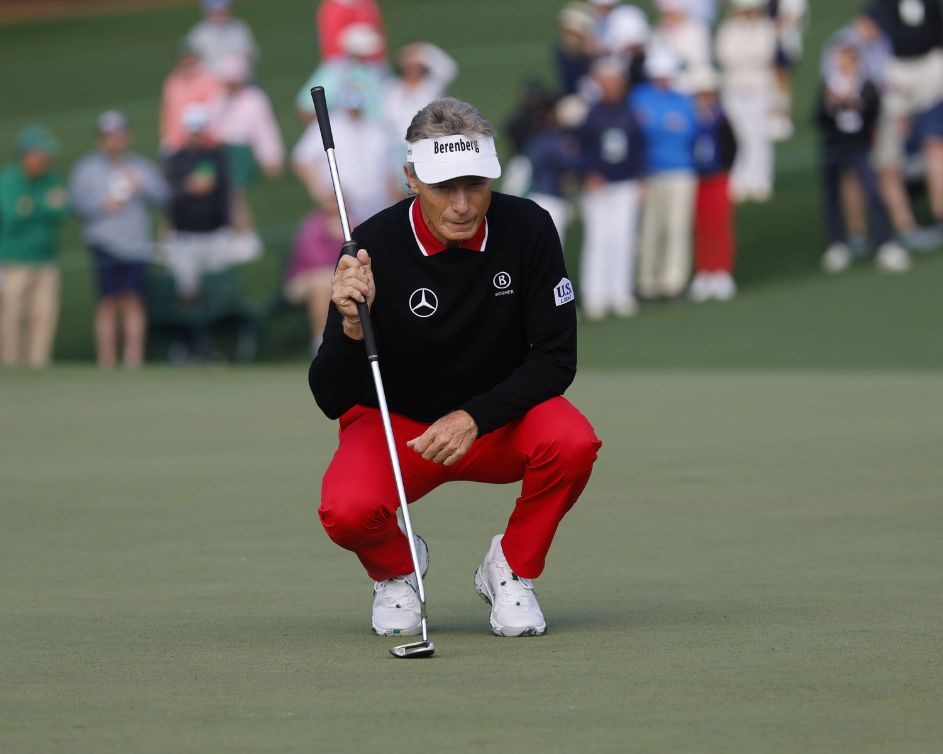
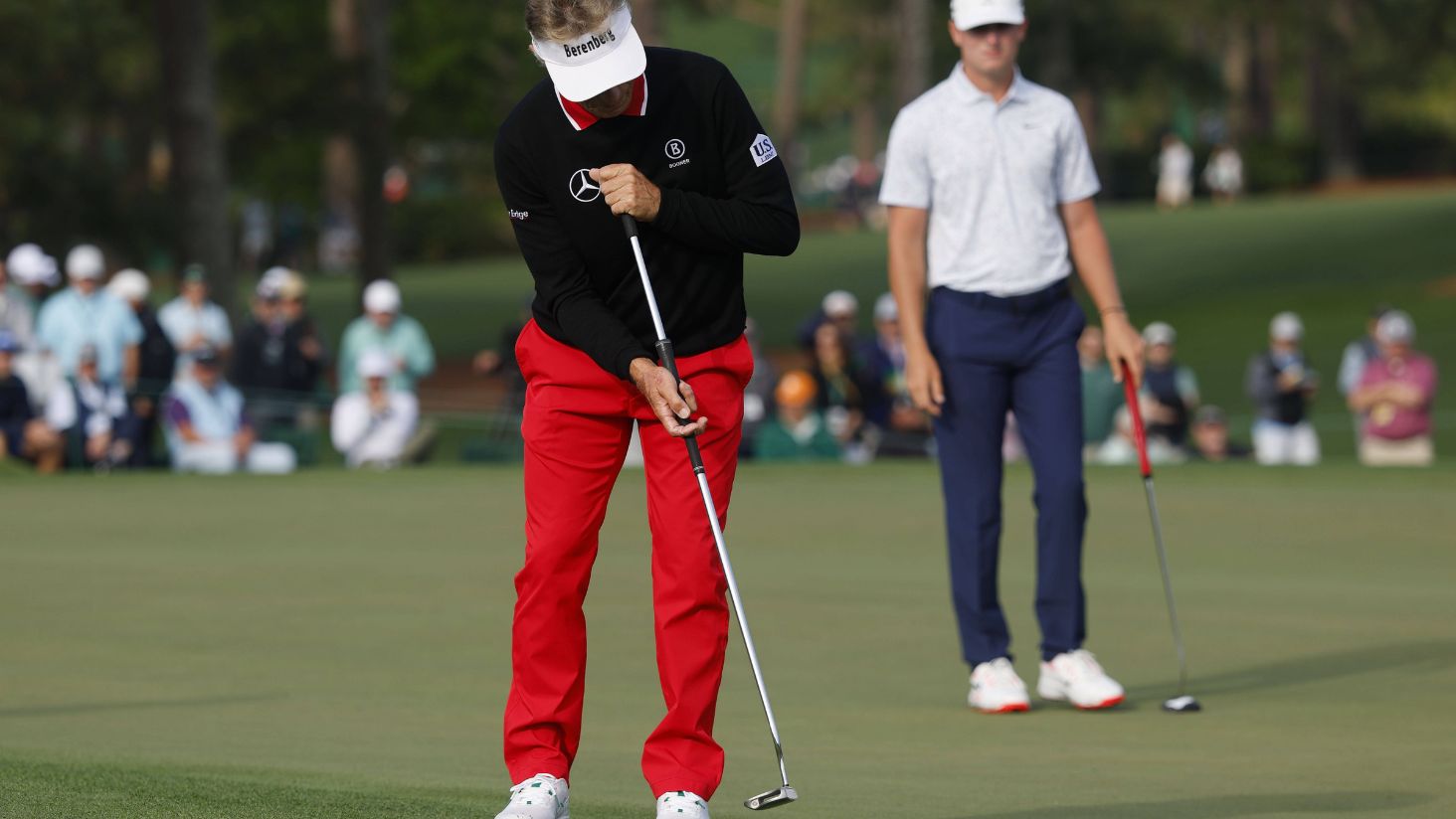
Bernhard Langer is the best-known example of the gray area surrounding this rule. After a long battle with the yips in the late 1990s, the two-time Masters champion switched to a broomstick Putter—and went on to dominate the Champions Tour like few players before him.
After the anchoring ban, Langer made a minor adjustment to his technique: He lifted his hand slightly off his chest—just enough so that there was no longer direct contact. The USGA reviewed his technique and officially gave it the green light. Nevertheless, the debate continues: To many observers, Langer’s stroke still looks like anchoring. To the rulemakers, it does not.
Langer still uses his broomstick Putter to this day—and continues to win with it on the PGA Tour Champions.
The Armlock Today: Rule-Compliant and on the Rise
While belly and broomstick putters have all but disappeared from the PGA Tour following the anchoring ban, the armlock putter is experiencing a true renaissance. The reason: It offers many of the biomechanical advantages of long Putters—calmer wrists, a more controlled pendulum motion—without the rule issues.
The principle is elegant: The grip rests along the forearm, and the arm itself becomes a stable guide. The motion comes from the shoulder, not the wrist. This significantly reduces the risk of yips-induced mishits. Probably the best-known Armlock putter user right now is Bryson DeChambeau. The major champion currently plays on the LIV Golf tour and entertains his fans with golf videos on his YouTube channel, among other platforms.
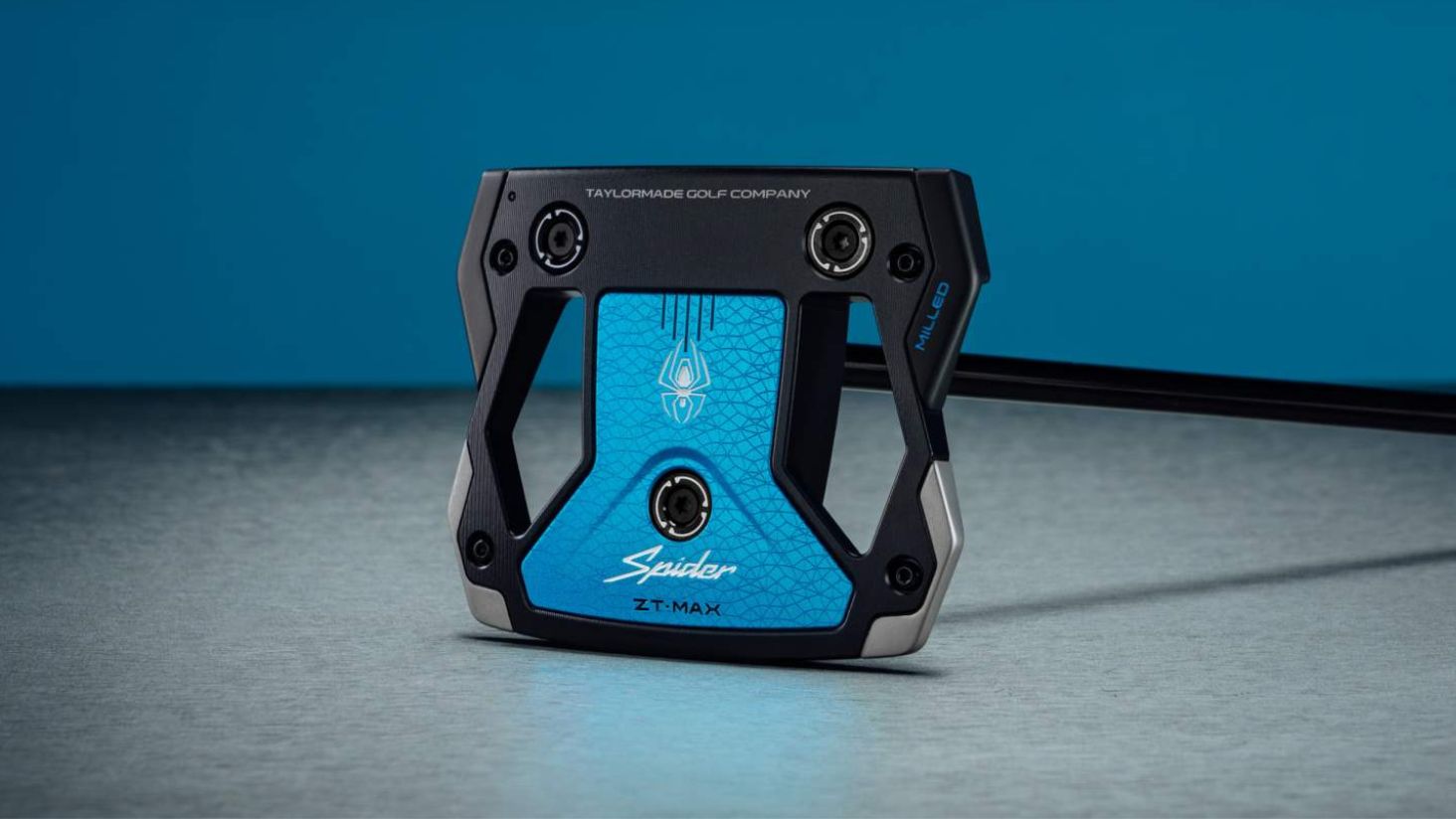
Modern armlock models—such as the Spider ZT Black CB from TaylorMade, available in lengths up to 38 inches and featuring a specially tuned graphite shaft—demonstrate just how seriously the industry now takes this category. The counterbalance concept—in which a heavier grip shifts the Putter’s center of gravity toward the hands—is closely related to the armlock principle: In both cases, the goal is to take the wrists out of the equation.
Learn more about TaylorMade Spider putters here.
Happy Gilmore—How a Movie Hero Made the Broomstick Putter Famous
For many people outside the golf world, the broomstick Putter is inextricably linked to one name: Happy Gilmore.
In the 1996 cult comedy of the same name, Adam Sandler plays a failed hockey player who ends up on the golf course—and sinks putts there with a hockey stick Putter. The stick Happy uses at the end of the movie visually resembles a long Putter and has since become an iconic symbol of the underdog golfer with an unorthodox style.
In 2025, Adam Sandler returned to Netflix with *Happy Gilmore 2* —and with it, renewed interest in this unique club. Odyssey, part of the Callaway Group, produced a limited-edition hockey stick Putter specifically to promote the film: 44 inches long, 57-degree lie angle, equipped with Odyssey’s famous White Hot insert. Not a tournament putter, but impressive proof of just how much cultural impact a single moment in a movie can have.
To be clear: The Happy Gilmore putter is a pop culture reference, not an actual putter design. Broomstick putters in golf are technically precise tools developed to solve a very specific problem—with a long, distinguished history on professional Tours worldwide.
Who should consider a long Putter?
A long Putter is not a cure-all—nor is it an entry-level product. It solves a specific problem, and only those who have that problem should seriously consider it.
Long putters can be useful for:
- Golfers who suffer from the yips —that is, involuntary wrist or finger twitches at the moment of impact
- Players with physical limitations that require a more upright stance when putting (e.g., back problems)
- Golfers with a fundamentally unstable stroke that does not stabilize despite practice
When a long Putter isn’t the solution:
Poor putting results are often not due to the club, but rather to reading the line (reading the green), distance control, or basic swing technique. If you simply miss the hole more often, you generally don’t need different equipment—but rather more practice with the right feedback.
Recommendation: Anyone seriously considering a long Putter should first consider a professional Putter fitting. Modern systems like SAM PuttLab precisely analyze your stroke and reveal whether the problem is actually mechanical in nature—or whether other factors are more significant.
FAQ – Frequently Asked Questions About Broomstick Putters
Are broomstick Putters banned?
The club itself is not banned. Since January 1, 2016, anchoring the Putter to the body has been prohibited (Rule 10.1b). Broomstick putters may still be used—as long as the top end is not actively pressed against the chest or chin.
What is the difference between a belly Putter and an armlock Putter?
The belly Putter (approx. 43 inches) was stabilized against the navel—this technique has not been permitted since 2016. The armlock Putter (40–42 inches) is pressed against the forearm with the grip, without body contact in the sense of anchoring. It is fully compliant with the rules.
Do armlock Putters require more loft?
Yes. Since the shaft is tilted slightly forward when pressed against the forearm, more loft is needed at impact to normalize the effective loft. Most armlock models come with 5 to 7 degrees of loft.
What does Happy Gilmore have to do with long Putters?
In the movie “Happy Gilmore” (1996), the main character, Happy Gilmore, plays with a hockey stick Putter. For the sequel, “Happy Gilmore 2” (2025, Netflix), Odyssey produced a limited-edition movie-style hockey stick Putter. The term “Happy Gilmore Putter” usually refers to this movie club—not a real broomstick Putter in the sporting sense.
Does anyone else on the Tour still play with a broomstick Putter?
Yes. Bernhard Langer is the best-known example: He continues to use his long Putter on the PGA Tour Champions—with a modified technique that was officially declared compliant with the rules by the USGA following the ban on anchoring.
Brandname
Title will go here and can run on two lines
Brandname
Title will go here and can run on two lines

Brandname
Title will go here and can run on two lines
Brandname
Title will go here and can run on two lines
Brandname
Title will go here and can run on two lines
Brandname
Title will go here and can run on two lines
Brandname
Title will go here and can run on two lines
Brandname
Title will go here and can run on two lines
Brandname
Title will go here and can run on two lines
Brandname
Title will go here and can run on two lines
Release date
10 Aug 2026
photos
Bernhard Langer is probably the best-known golfer who uses a broomstick Putter. (Photo: Imago / EPA)