Golf balls out of bounds: rule, penalty and provisional ball
Ball out of bounds? We explain penalties (stroke and distance), provisional ball and when a local rule allows the alternative with 2 penalty strokes.
Short answer
A golf ball out of bounds is outside the boundaries of the course. According to the basic rule, players then only have "stroke and distance": A penalty stroke is added and the next ball is played from the spot of the previous stroke. To save time, a provisional ball should often be played if an out is suspected.
Starting scenario
The ball flies towards the white stakes or fence. Many players are unsure: Is that already out? What is the penalty? Can the ball be dropped? And when does a provisional ball help? This article takes you through the basic rules and the most important exceptions in practice.
"Golf balls out of bounds" explained in 30 seconds (checklist)
- Possible out? Then a provisional ball is often worthwhile.
- Announce the provisional ball ("I'm playing a provisional ball") and play.
- Look for the original ball and check: in play or out?
- If the original ball is out of play or lost: Stroke and distance applies - the provisional ball becomes the ball in play.
- The alternative with 2 penalty strokes is only available if a local rule is expressly in force.
What does "out of bounds" mean in golf?
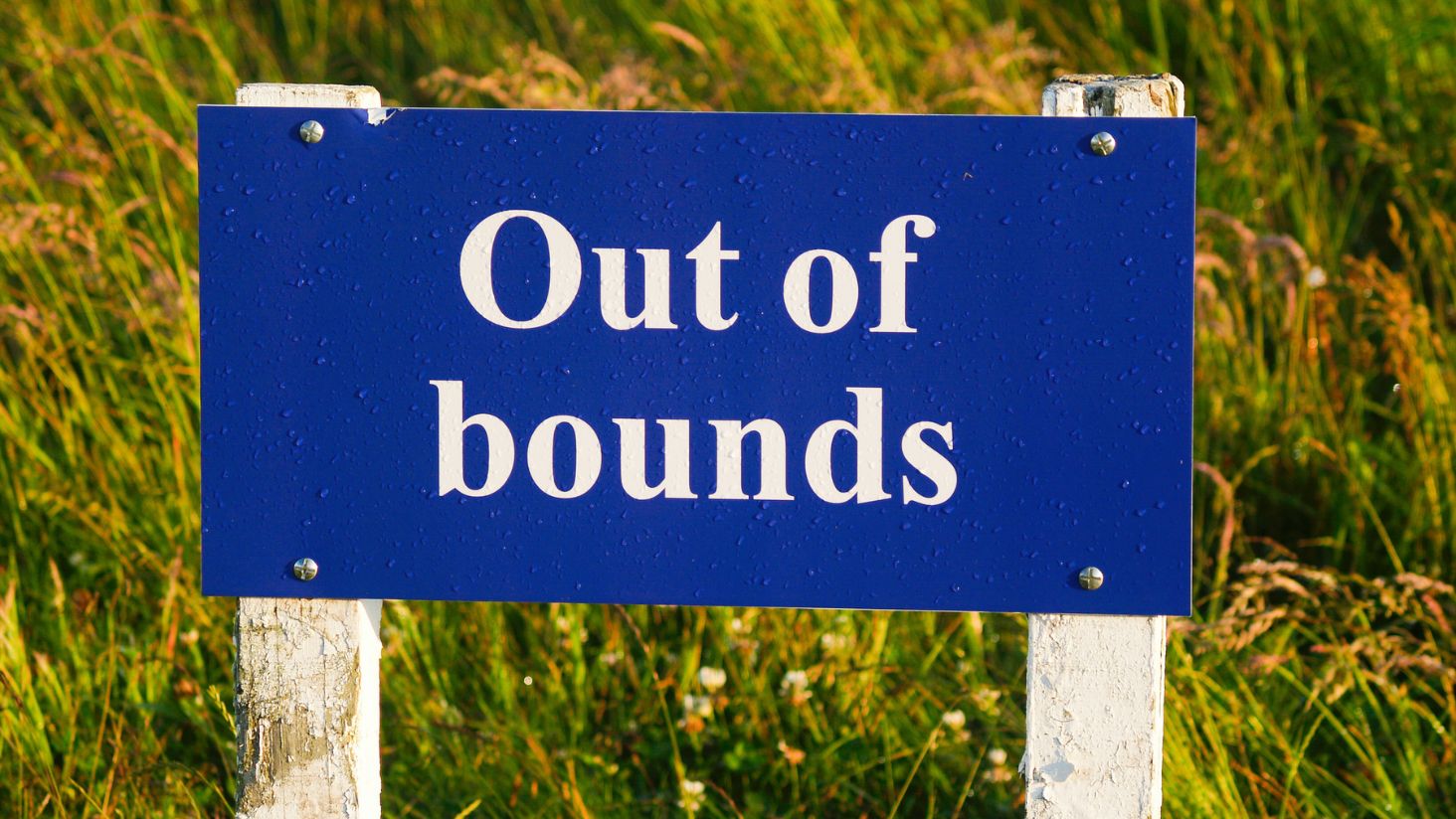
Out of bounds means that the ball is outside the boundaries of the course and is therefore not in play. Colloquially, many people say "ball out of bounds", but in terms of the rules it means out of bounds.
How do players recognize out of bounds?
Court boundaries are often marked by
- white posts,
- Fences,
- Lines or other clear boundary markings.
Which markings apply on the respective course and exactly how the boundary is defined is usually stated in the local rules or on the scorecard.
Out is not a penalty area
Important for the correct decision: Out is not an obstacle with drop options like a penalty area. If you confuse out and penalty area, you will quickly apply the wrong relief.
Rules of golf for penalty areas: dropping, options and penalties explained
What penalty applies if a ball is out of bounds? (basic rule)
Basic rule: Stroke and distance loss (Stroke and Distance)
If a ball is out of bounds, the basic rule is stroke and distance loss:
- a penalty stroke, and
- You (or the player) must return to the spot of the previous stroke and play the next ball from there.
This is the reason why off can be so "expensive": Not only does the penalty stroke count, but the way back also costs time.
Can you drop on an out?
Basically no: According to the basic rule, there is no free drop "in the vicinity" on an out. Instead, stroke and distance apply.
But: There is an optional local rule which - if it is in force - can allow an alternative to Stroke and Distance. This alternative is explained in the next section.
Drop rules in golf: What is a drop - and how do you drop correctly?
"2 penalty strokes for out" - is that true?
Many players have already heard: "If you're out, it's two penalty strokes and you drop in the Fairway." This is not the general basic rule, but can only be true if an optional local rule (course rule) expressly applies.
Why do many people talk about "2 penalty strokes"?
Because there is an alternative that some courses activate for certain types of play. This alternative is intended in particular for recreational/casual rounds and is not generally recommended for competitions with top-class players.
Optional Local Rule: Alternative to Stroke and Distance (2 penalty strokes)
If this local rule is in force, the following simplified rules apply:
- For two penalty strokes, players may estimate where the ball was lost or went out of bounds.
- Then the nearest Fairway edge (not closer to the hole than the estimation point) is taken as reference.
- The drop takes place in the Fairway:
- within two club lengths of the Fairway edge point or
- somewhere in the area between this point and the estimated point where the ball was lost/off (without coming closer to the hole).
Important: This option only applies if it is explicitly activated in the Course Rules/Local Rules. In tournaments, players should therefore always check whether this local rule applies or is expressly excluded.

The correct procedure in practice (step by step)
Step 1: Assess - could the ball be out of bounds or lost?
If it is realistic that the ball could be out of bounds or not be found, a provisional ball often saves a lot of time.
Step 2: Play the provisional ball correctly (Provisional ball)
A provisional ball must be clearly announced before the shot, for example: "I'm playing a provisional ball."
This is important so that it is clear to everyone involved that this ball is only a safeguard.
Step 3: Look for the original ball and decide
The following applies:
- Original ball found and not out: the provisional ball is given up.
- Original ball out or lost: The provisional ball becomes the ball in play (under Stroke and Distance) and you do not have to run back to the spot of the previous shot.
Provisional ball: the most common mistakes (and how to avoid them)
Mistake 1: Provisional not clearly announced
If it is not clearly stated that it is a provisional ball, a "second ball" can quickly be regarded as the ball in play - with unpleasant consequences.
Mistake 2: Provisional ball played too late
A provisional ball must be played before players move forward and search for/find the original ball.
Error 3: Provisional ball continued to be played although the original ball was in play
If the original ball is found and is in play, the provisional ball may not simply be played "conveniently".
Error 4: Provisional ball vs. "second ball" mixed up after rule decision
In some situations, a second ball is played for other reasons (e.g. in the event of an uncertainty in the rules of the tournament, a so-called regulation ball). This is not the same as a provisional ball. If in doubt, it helps to communicate clearly and ask the committee at tournaments.
Difference: ball out of bounds vs. ball lost (short & decisive)
- Out of bounds: The ball is out of bounds.
- Lost: The ball is not found (the search is limited in time).
Golf balls out of bounds: special cases
Ball close to fence or post: "Is that already out?"
Whether a ball is out depends on how the course boundary is defined on the respective course. If you are unsure, consult the Local Rules or the tournament committee.
Out on the tee
The following also applies on the tee: out of bounds is always a loss of stroke and distance. A provisional ball is often particularly useful here, as otherwise the alternative would usually be to return to the tee.
Does Stableford or counting play change anything?
The rules for off remain the same. Differences arise more from how the scoring format deals with errors/penalty strokes (e.g. whether a hole is canceled). However, the correct sequence of rules for out remains the same.

FAQ: Frequently asked questions about "ball out of bounds"
What does "golf balls out of bounds" mean?
A golf ball is out of bounds when it lies outside the boundaries of the course (out of bounds). It is then no longer in the playing area.
What is the penalty for out of bounds?
According to the basic rule, stroke and distance applies: one penalty stroke plus the next stroke from the position of the previous stroke.
Are there 2 penalty strokes for out of bounds?
Two penalty strokes can only be relevant if an optional local rule expressly permits an alternative to stroke and distance. Without this local rule, the basic rule (stroke and distance) applies.
Can you drop on an out?
According to the basic rule, there is no drop "in the vicinity" on an out. A drop as an alternative is only possible if a corresponding local rule is in force.
When should a provisional ball be played?
When it is realistic that the ball could be out of bounds or cannot be found. It is important to clearly announce the provisional ball beforehand.
Conclusion
- Out of bounds means: ball outside the boundaries of the course.
- According to the basic rule, stroke and distance loss applies.
- Two penalty strokes with a drop in the Fairway are only possible if a local rule expressly provides for this alternative.
- A provisional ball saves time and prevents unnecessary returns.
Brandname
Title will go here and can run on two lines
Brandname
Title will go here and can run on two lines

Brandname
Title will go here and can run on two lines
Brandname
Title will go here and can run on two lines
Brandname
Title will go here and can run on two lines
Brandname
Title will go here and can run on two lines
Brandname
Title will go here and can run on two lines
Brandname
Title will go here and can run on two lines
Brandname
Title will go here and can run on two lines
Brandname
Title will go here and can run on two lines
Release date
30 Apr 2026
photos
You can recognize the out of bounds on a golf course by the white posts. (Photo: Adobe Stock)