Golf ball construction and production: everything about material, trajectory and speed
How are golf balls made? What is a golf ball made of? How far can a golf ball fly? What does a golf ball look like inside? Here are the answers.
Have you ever wondered what is actually going on inside the little white ball when you tee off? A golf ball is no longer a simple toy, but a technological masterpiece. In this guide, we take a deep dive into the golf ball cross-section and explain everything from production and golf ball material to aerodynamics. We also reveal how far a golf ball can fly.
The structure: What's inside a golf ball?
If you look at a golf ball from the inside, you quickly realize that it is a complex multi-layer system. But what exactly is a golf ball made of? The modern golf ball structure usually consists of a core, one or more cover layers and the shell. All layers are made of different materials and give the golf balls different properties depending on the composition and number of layers.
- The core: It is the center of power. When the question "What is a golf ball made of?" is asked, the answer is usually: high-purity polybutadiene rubber.
- The material of the (outer) shell of the golf balls: A distinction is primarily made here between Surlyn (durable) and urethane (soft, more spin).
- The experiment: If you were to drill through a golf ball, you would usually find a solid core. Earlier models often contained liquids or wound rubber threads - today, the focus is on maximum energy transfer through solids.

How are golf balls made?
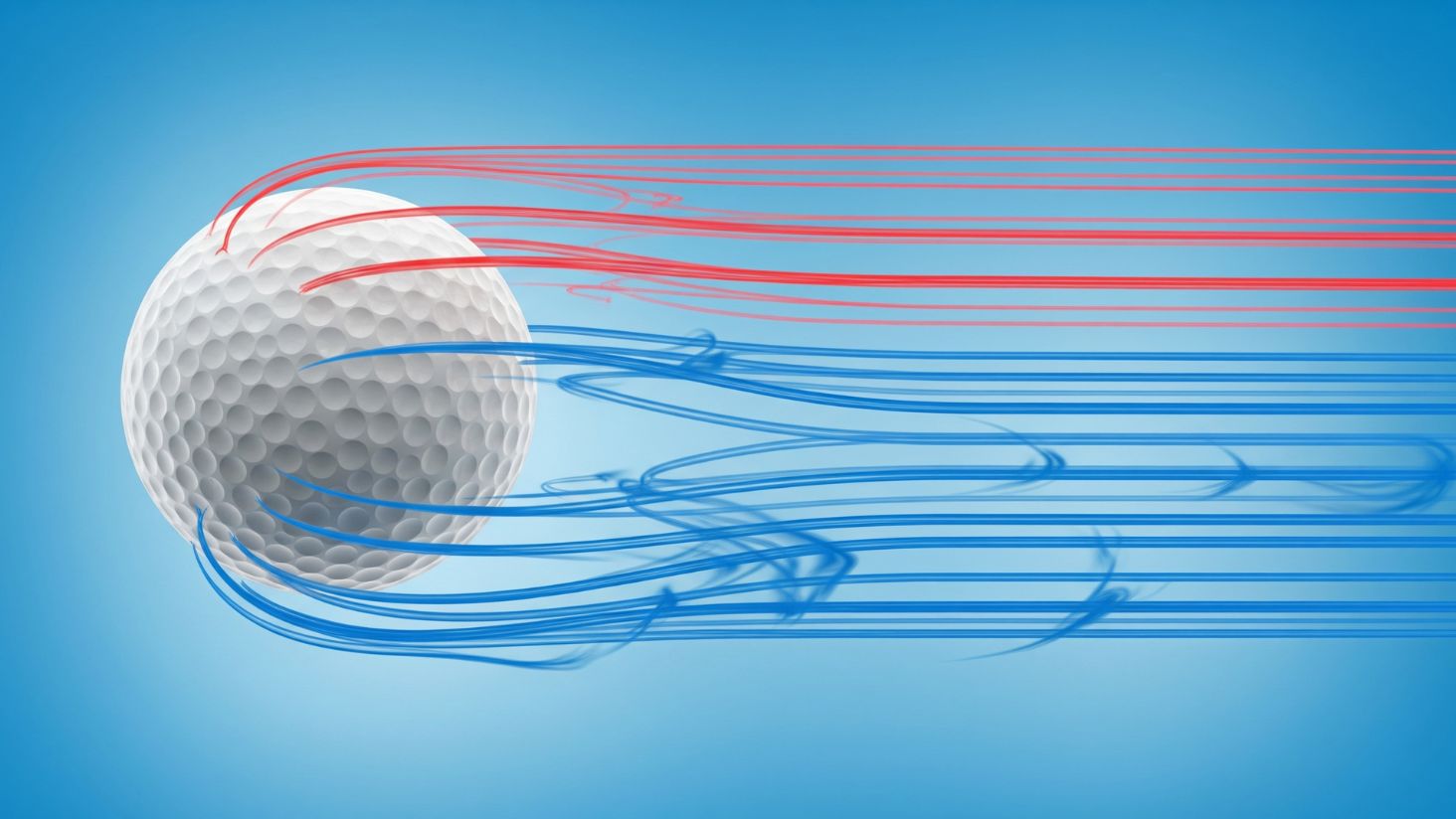
The production of golf balls is a precision process. First, the material mixture of the core is made from synthetic rubber and other raw materials. Then the core of the golf ball is molded under high temperature and pressure. After the cores have cooled down, the layers are molded around the core. In the next step of the production process, the surface of the golf balls is injection molded with the characteristic dimples. These small dimples are crucial as they halve air resistance and maximize lift.
Find out more about dimples and what happens when a golf ball has no dimples here.
Golf balls compression: The compression factor
An important term for every player is golf ball compression. It describes how much the ball deforms at impact. A ball with low compression is easier to compress and is ideal for players with a slower swing speed in order to generate more distance. The compression creates the so-called trampoline effect, which additionally accelerates the golf balls.
Golf ball elasticity is fantastic. Pushing compression to the max!#compression #elastic #golfball #elasticity #inspire #STEM #STEMeducation #engineering #dreambig #fightgrindrepeat #inspireengineering pic.twitter.com/S0yf8hqG82
- Inspire Engineering (@InspireEngring) June 27, 2020
Golf balls: speed and trajectory
As soon as the club hits the ball, physics takes over. The acceleration of a golf ball is enormous: from 0 to maximum speed in milliseconds. For very good golf pros on the PGA Tour or DP World Tour, the club hits the golf ball at approx. 125 mp/h (approx. 201 km/h). This accelerates the ball to approx. 190 mp/h (approx. 305 km/h). The fact that the speed of the ball is higher than that of the club is due to the trampoline effect. In addition to transferring the kinetic energy of the golf club, the golf ball absorbs further energy through deformation (compression) and literally bounces off the club face.
How fast does a golf ball fly?
- Speed: The maximum speed of golf balls for professional golfers can be well over 300 km/h. But what is the average speed of a golf ball? Good amateur players reach speeds of around 200 to 230 km/h.
- World record: The fastest golf ball speed ever measured was set by Seb Twaddell in January 2025. He accelerated the golf ball to 246.8 mp/h (397.2 km/h).
How far does a golf ball fly?
- Distance: The questions "How far does a golf ball fly?" or "How far can you hit a golf ball?" cannot be answered in general terms. While amateurs often land at 180-210 meters, long drivers regularly break the 350-meter mark.
- The longest golf ball ever measured flew 529 meters and was hit by Kyle Berkshire. The "monster drive" was made in Wyoming, 2,000 meters above sea level. However, due to varying weather conditions, air density and wind influences, there is no official world record for the longest golf shot, although the Guinness World Records do hold one.
- Trajectory and height: The golf balls trajectory is stabilized by the spin and the dimples. The flight height of golf balls depends on the launch angle - professionals with modern drivers often hit the ball into a window of 25 to 35 meters. The launch angle indicates the angle at which the golf ball rises into the air after launch.
Excursus: The golf ball on the moon
A brief piece of sporting history: in 1971, Alan Shepard hit a golf ball on the moon. As the first attempt failed, he also hit the second of the golf balls that he had smuggled onto the Apollo missoin. With no air resistance and only one sixth of the Earth's gravity, the question arose: how far can you hit a golf ball when there is no atmosphere to slow it down? Shepard's ball flew - according to him - "miles and miles". In reality, it was only just under 40 meters. In theory, however, an optimally hit ball could fly several kilometers on the moon! However, Shepard's space suit prevented a proper swing.
Brandname
Title will go here and can run on two lines
Brandname
Title will go here and can run on two lines

Brandname
Title will go here and can run on two lines
Brandname
Title will go here and can run on two lines
Brandname
Title will go here and can run on two lines
Brandname
Title will go here and can run on two lines
Brandname
Title will go here and can run on two lines
Brandname
Title will go here and can run on two lines
Brandname
Title will go here and can run on two lines
Brandname
Title will go here and can run on two lines
Release date
01 Feb 2026
photos
Find out in this article how a golf ball is made, what material it is made of and how far and fast a golf ball can fly. (Photo: Adobe Stock)