


Where Are Callaway Clubs Manufactured? An Explanation of Production Sites and the Supply Chain
Callaway develops its products in Carlsbad, California; assembles many of its clubs in Monterrey, Mexico; and relies on an international network of suppliers, with a focus on Asia.
Callaway develops new technologies and club designs in Carlsbad, California. The final assembly of many golf clubs takes place in Monterrey, Mexico. Components and semi-finished products come from an international supplier network centered in Asia (including China, Taiwan, and Vietnam; and to some extent, Indonesia and Thailand). Callaway also operates a golf ball manufacturing facility in Chicopee, Massachusetts.
Anyone wondering where Callaway golf clubs are manufactured is usually looking for a simple country designation. The reality—as with most major golf brands—is more complex: development, component manufacturing, and final assembly are spread across several regions. This is not at odds with quality, but rather a typical model in the modern golf industry.
In this article, we’ll outline Callaway’s key production sites, explain the logic behind the global supply chain, and show what origin labels like “Made in …” or “Assembled in …” actually mean in practice.
Who owns Callaway? Find out here.
The Role of Carlsbad, California: Development, Testing, and Innovation
Carlsbad is considered the hub of Callaway’s product development. This is where ideas, designs, and test scenarios are developed before a club goes into production. In practice, this means that engineering teams define the specifications (e.g., target values for center of gravity, wall thicknesses, tolerances for loft/lie, and weights) and pass these specifications on to the manufacturing and assembly chain.
Important: “Developed in the U.S.” does not automatically mean “entirely manufactured there.” What matters is that the technical specifications, testing criteria, and approval processes are consistent.
Final Assembly in Monterrey, Mexico: Where Components Become Finished Clubs
A central component of Callaway’s manufacturing model is final assembly in Monterrey, Mexico. There, clubs are assembled from components into a final product—including the attachment of the shaft and grip, as well as final quality controls.
Typical steps in final assembly (simplified):
- Inspection/sorting of components according to specifications
- Bonding/joining the head and shaft, curing
- Length and swing weight adjustment
- Alignment/grip installation
- Final visual and dimensional inspection, followed by packaging
This is particularly relevant for customers because country-of-origin labeling for golf clubs often applies to the location where the “substantial transformation” into the finished product takes place.
Components & Supplier Network: Why Asia Is So Important in Golf Club Production
In modern golf clubs, many components and intermediate products come from specialized manufacturing regions. At Callaway, the focus is on Asia—particularly China, Taiwan, and Vietnam; depending on the product category, Indonesia and Thailand may also play a role as sourcing or manufacturing locations.
Suppliers from 20 Countries
In an overview of supplier locations for 2021, Callaway reported that the company’s brands worked with manufacturing suppliers from 20 countries —with a focus on Asia. It was also noted that the largest share of external production volume came from China, Indonesia, Taiwan, and Vietnam. The report states: “In 2021, the Callaway brands collaborated with manufacturing suppliers from 20 countries, with the majority of these countries located in Asia. The largest share of external production volume comes from China, Indonesia, Taiwan, and Vietnam.”
Why Using Multiple Countries Is Common
Clubheads (cast/forged), multi-material constructions, high-quality coatings/finishes, and precision metalworking require specialized manufacturing expertise and supply chains. That is why many golf brands rely on a model that brings together global specialists and unifies them through defined specifications and quality inspections.
“Made in …” and “Assembled in …”: What Country-of-Origin Labels Really Mean
Country-of-origin labels often lead to misunderstandings. For complex products like golf clubs, what matters isn’t where each individual component is manufactured, but in which country the final assembly and inspection take place.
A practical rule of thumb:
- “Assembled in …” indicates final assembly or completion.
- “Made in …” is used, depending on the regulations, to indicate where the essential manufacturing or processing step takes place.
For buyers, the logical conclusion is this: The label provides information about the product’s origin—but it is not the sole indicator of quality.
Quality: Why Location Matters Less Than Process and Quality Control
Whether a club is consistent depends primarily on measurable factors:
- defined tolerances (loft, lie, head weight, length, swing weight)
- standardized assembly processes (curing, bonding, alignment)
- Inspection chains (dimensional checks, visual inspection, serial number/batch tracking)
If a brand manages and monitors these aspects consistently across the globe, quality can be maintained at a stable level regardless of location.
Golf Balls: Manufacturing in Chicopee, Massachusetts (USA)
In addition to club production, golf ball manufacturing also plays a role at Callaway. One well-known location is Chicopee, Massachusetts. Depending on the model and production mix, golf ball production may also be supplemented by additional manufacturing or supplier partners.
Three key aspects can be clearly derived from an on-site report by Alex Gonzales for Sports Illustrated on the Chicopee plant (Nov. 2025): First, the process is heavily driven by materials and chemistry (core mixtures, polymer formulations); second, there is a great deal of measurement and automated testing (e.g., compression tests and visual inspections); and third, aerodynamics —specifically the dimples—play a central role and are tested in many variations. The article also mentions an investment in new technology totaling approximately $100 million.
Read all about the weight, size, and dimples of a golf ball here.
In the context of our article, the most important point is this: golf clubs and golf balls often follow different production logics. While clubs are heavily influenced by component supply chains and final assembly, golf ball production is more of an end-to-end process with clearly defined material and process parameters (core, cover layers, cover, coating, and testing).
Find out here how a golf ball is made.
FAQ: Frequently Asked Questions About Callaway Manufacturing Locations
Are Callaway clubs manufactured in the U.S.?
Callaway develops its products in the U.S. (Carlsbad, California). Final assembly of many clubs takes place in Monterrey, Mexico. Components are sourced from an international network of suppliers.
Why are components sourced from Asia?
Because there are highly specialized manufacturing capabilities and industrial clusters there that enable the production of modern, precise multi-material designs in large quantities.
Does “Made in …” automatically mean better quality?
Not necessarily. Specifications, tolerances, process control, and quality assurance are more important.
Where are Callaway golf balls manufactured?
A well-known production site for Callaway golf balls is Chicopee, Massachusetts. Depending on the model, there may be additional manufacturing or supplier partners.
Brandname
Title will go here and can run on two lines
Brandname
Title will go here and can run on two lines

Brandname
Title will go here and can run on two lines
Brandname
Title will go here and can run on two lines
Brandname
Title will go here and can run on two lines
Brandname
Title will go here and can run on two lines
Brandname
Title will go here and can run on two lines
Brandname
Title will go here and can run on two lines
Brandname
Title will go here and can run on two lines
Brandname
Title will go here and can run on two lines
Release date
12 Jul 2026
photos
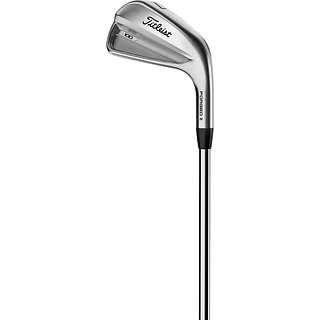
Callaway manufactures its golf clubs and golf balls at various locations. In this article, you'll find out where. (Photo: Adobe Stock / piter2121 - stock.adobe.com)