


A Socket in the Golf – What's Behind the Most Dreaded Mistake?
Socket, shank, hook—one bad shot, many names. What makes it so dreaded, and why even pros like Tiger Woods are familiar with it.
There is an unwritten rule in golf that isn’t listed in any course regulations but is nonetheless respected by experienced players worldwide: You don’t say the word out loud. Not on the course, not on the driving range—preferably not anywhere within earshot of a golf course. In the English-speaking world, theater professionals are familiar with a similar phenomenon: “Macbeth” is also referred to behind the scenes as “the Scottish Play”—out of fear that saying the name aloud might bring bad luck. In golf, this superstitious unease centers on a single mishit: the “socket.”
In this article, you’ll learn exactly what’s behind it, why it plagues even world-class players—and why psychology often plays a decisive role in this.
What Is a Socket in Golf? – Definition and Causes
Socket, shank, or heel hit—what’s the difference?
Depending on which part of the golfing world you’re in, you’ll encounter this mishit under different names. In the UK and Australia, the term “socket” is commonly used, while in American English, “shank” is the predominant term. In German, the term “Hackentreffer” has also become established alongside “Socket.” All three terms refer to the same mishap.
Incidentally, the word “shank” has a long history: It originates from Old English, which is of West Germanic origin, and originally referred to the lower leg—think of “lamb shank” on a menu. As a golf term, it has likely been in use since the 1920s.
Be sure to shout “Fore!” if your golf ball is heading in an unexpected direction. Here’s why.
What happens physically during a “socket”?
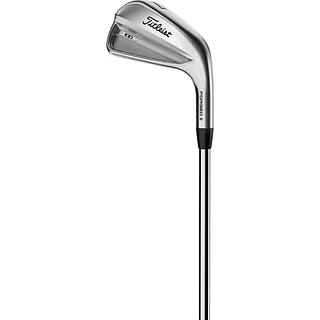
In a “socket,” the ball doesn’t hit the clubface but rather the hosel —the joint between the shaft and the clubhead. This area is located at the heel of the clubhead, right where the shaft meets the head. Since the hosel is rounded, the ball can be deflected in almost any direction after contact—for right-handed players, typically sharply to the right, flying low and with high lateral velocity.
Unlike a topped shot or a thin shot, which at least have some predictability, the “socket” is the most unpredictable of all mishits. The ball often misses the target so significantly that the entire shot is considered a lost one. The “socket” occurs particularly frequently with Irons and Wedges —typically right when golfers are trying to play short, controlled approach shots.
Size, Weight, Dimples: Everything You Need to Know About Golf Balls.
Why Does a “Socket” Happen?—An Overview of the Most Common Causes
Note: The following points provide a general overview of possible causes. An individual analysis and targeted correction should be handled by a qualified golf instructor.
Too close or too far—the wrong distance from the ball
One of the most common causes of a “socket” lies in the address position itself. If you stand too close to the ball, you risk the club making contact with the ball from the outside during the downswing—the hosel inevitably moves into the strike zone. But the opposite scenario is also tricky: If you stand too far from the ball, you run the risk of the swing momentum pulling your body forward at the moment of impact—with the same undesirable result.
As a rough guideline: There should be about a hand’s width of space between your thigh and the end of the grip in the address position. This simple check can help you find the correct distance.
Hit the socket? Be sure to shout “Fore!” Here’s why.
Swing Path, Weight Shift, and Early Extension
Aside from distance, errors in the swing path can also cause a “socket.” A so-called outside-in path—where the clubhead strikes the ball from the outside—significantly increases the risk, as the hosel is literally driven toward the ball. The same applies to “sliding”: If your knees slide toward the target during the downswing, the entire swing arc shifts outward.
Another frequently underestimated phenomenon is early extension: If the hips shift toward the ball during the downswing, the upper body straightens up too early—the club departs from its ideal path, and the hosel makes contact.
Why does this affect even experienced players?
The “socket” isn’t just a beginner’s problem. That’s perhaps its most unsettling characteristic. It affects golfers of all skill levels—and doesn’t even spare the world’s best. Henrik Stenson, one of the best players of his generation, hit a “socket” on the second hole at a tournament in Doral—in front of rolling cameras and an audience of millions. Tiger Woods, arguably the most famous golfer of all time, used the telling phrase “presented hosel” after his own mishap—a matter-of-fact description for a shot that seems anything but matter-of-fact. Anthony Kim also joined this inglorious list.
This shows that technique alone doesn’t protect against a “socket.” What makes it truly dangerous runs deeper.
Carry, pull, or push—what difference does a golf Trolley really make? Find out here.
The Psychological Abyss—Why the “socket” is so feared
The self-reinforcing effect
What sets the “socket” apart from other mishits is its psychological aftereffect. A single “socket” can be enough to permanently shake your confidence in your own swing. And that’s precisely where the real danger lies: The fear of the next “socket” subconsciously alters your movement patterns—your swing becomes tense, your body reacts differently than usual, and the likelihood of another hosel hit increases.
This mechanism is similar to what is known in golf as the “yips ”: a mental block that directly translates into physical dysfunction. Anyone who has ever fallen into this cycle knows how difficult it is to break free. American sports journalist Chris Powers described his experience after a “socket” episode during a dream trip to Bandon Dunes as follows: Even after the problem seemed to have been overcome, the memory remained—and with it, the question of whether the “socket” might return at some point after all.
Why Golfers Avoid Saying the Name
The cultural phenomenon surrounding the “socket” is remarkable: Many golfers consciously avoid saying the word on the course—as if the mere mention of it could cause a mishit. This superstitious aversion is not an isolated case, but a widespread behavior that cuts across all skill levels. Tiger Woods’ euphemism “presented hosel” is merely the best-known example of an attempt to sidestep the unmentionable.
The parallel to the theater is striking: Anyone who says “Macbeth” behind the scenes is considered to be tempting fate. Many golfers believe that anyone who uses the S-word on the golf course risks the same thing.
TaylorMade Spider Putters: Compare all models here.
The Socket as a Crisis of Confidence
Beyond superstition, the socket strikes a nerve with golfers: their self-confidence. Especially in high-pressure situations—during a tournament, while chasing a personal best round, or on a difficult hole—a single “socket” can derail the mental state of an entire round. It not only costs you the shot itself but also casts a shadow over every subsequent approach shot.
A comparison from golf literature offers some consolation: A “socket” is similar in its progression to a 24-hour stomach virus. It can strike quickly and violently—but often disappears just as abruptly as it arrived. The memory, however, remains.
Can equipment contribute to a “socket”?
Club Length and Fitting: An Underestimated Factor
In addition to swing technique and psychology, there is a third factor that is often overlooked when it comes to the “socket”: equipment. An incorrectly chosen club length can structurally increase the risk of a “socket.” If the club is too long, the natural range of motion in the swing changes—the clubhead traces a wider arc, and the hosel moves closer to the ball.
The same applies to the lie angle: if it doesn’t match the golfer’s individual swing geometry, it can distort the swing path in a way that makes a heel strike more likely. A professional club fitting can reliably identify and eliminate these equipment-related risk factors—before they become a problem on the course.
Discover the latest Callaway iron series here.
What a golf instructor can analyze—and what can’t be done online
No article—and certainly no video—can replace the individual analysis provided by an experienced golf instructor. This is because what causes a “sock” varies from player to player. While for one person the problem may be incorrect stance, for another it could be weight transfer or grip pressure.
Modern tools such as video analysis, golf simulators, or impact tape can help visualize the exact point of contact and identify patterns. Combined with a professional outside perspective, the cause of a “socket” can be reliably pinpointed in most cases—and specifically corrected.
The “socket” is feared, but not invincible
The “socket” is one of the most dreaded moments in golf—not because it’s technically difficult to understand, but because it affects so many levels at once: physical, mental, and sometimes even emotional. It affects beginners just as much as tournament pros, often strikes without warning, and leaves its mark far beyond the single shot.
The good news: The “socket” isn’t a permanent condition. Those who understand the causes, who are willing to have their equipment and technique professionally evaluated, and who recognize the psychological cycle—they have a good chance of permanently banishing this mishit from their game. Or at the very least: of finding themselves in the awkward position of having to say the word less often.
Brandname
Title will go here and can run on two lines
Brandname
Title will go here and can run on two lines

Brandname
Title will go here and can run on two lines
Brandname
Title will go here and can run on two lines
Brandname
Title will go here and can run on two lines
Brandname
Title will go here and can run on two lines
Brandname
Title will go here and can run on two lines
Brandname
Title will go here and can run on two lines
Brandname
Title will go here and can run on two lines
Brandname
Title will go here and can run on two lines
Release date
19 Aug 2026
photos
"Fore!"—you should definitely call out this when you hit a socket or a shank. (Photo: Imago / UPI Photo)